

Experts from technology, policy, and research communities gather during the Mobile World Congress to explore opportunities and governance challenges surrounding embodied artificial intelligence
The World Internet Conference Specialized Committee on Artificial Intelligence hosted an international forum in Barcelona focused on the emerging field of embodied artificial intelligence, bringing together global experts to discuss how this technology is shaping the next phase of AI development. The forum, titled “Embodied AI: Leading a New Paradigm of AI Development,” took place on March 3 during the Mobile World Congress, one of the world’s largest technology gatherings.
Embodied AI refers to artificial intelligence systems that are integrated into physical entities such as robots, autonomous machines, and smart devices capable of interacting with the real world. Unlike purely digital AI applications, embodied AI connects algorithms with physical sensors, movement, and environments, enabling machines to perceive and act in dynamic real-world settings.
The forum attracted more than 100 representatives from international organizations, technology companies, research institutions, and government agencies. Participants examined both the opportunities and the challenges associated with scaling embodied AI technologies while also exploring the need for international collaboration and governance frameworks.
Among the prominent speakers was Francis Gurry, vice-chair of the World Internet Conference and former director-general of the World Intellectual Property Organization. His remarks emphasized the growing role of intellectual property, innovation systems, and global cooperation in ensuring that AI technologies continue to advance responsibly.
Also speaking at the forum was Mohamed Ben Amor, director general of the Arab Information and Communication Technologies Organization, along with Lara Dewar, chief marketing officer of GSMA, the international organization representing mobile network operators worldwide. Their discussions highlighted the importance of cross-regional collaboration as AI becomes increasingly embedded in digital infrastructure and global communication systems.
Other industry and academic leaders also contributed insights into the future of embodied AI. Schahram Dustdar, co-chair of the WIC AI committee and a member of Academia Europaea, spoke about the role of interdisciplinary collaboration in advancing AI research and industry development. Dustdar also serves as president of the International Artificial Intelligence Industry Alliance and highlighted how cooperation between academia, technology companies, and policymakers is becoming essential to scaling next-generation AI systems.
Industry perspectives were represented by executives from several major technology firms. Zhang Dong, executive vice president of China Mobile, discussed how telecommunications infrastructure supports the deployment of advanced AI services. Nakul Duggal, executive vice president at Qualcomm Technologies, shared insights on the role of advanced chipsets and edge computing in enabling real-time AI decision-making within physical devices.
Meanwhile, Wang Xiang, senior vice president at ZTE, addressed how emerging networks and smart systems are expanding the practical applications of embodied AI across industries such as manufacturing, transportation, and smart cities.
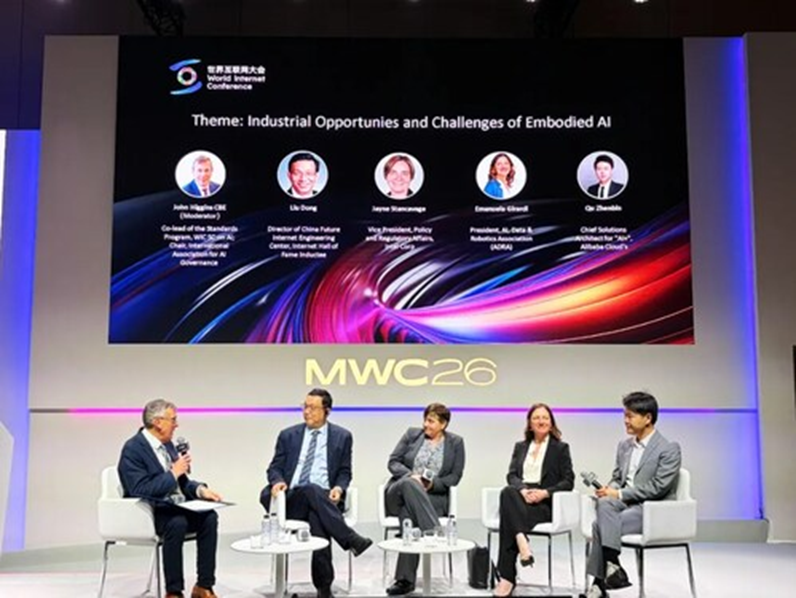
The event also included a roundtable discussion that brought together experts from technology policy, research, and enterprise sectors. The session was moderated by John Higgins, chairman of the International AI Governance Association and co-lead of the standards program within the World Internet Conference’s AI committee.
Participants in the discussion included Liu Dong, director of the China Future Internet Engineering Center and a member of the Internet Hall of Fame. They were joined by Jayne Stancavage, vice president for policy and regulatory affairs at Intel Corporation, along with Emanuela Girardi, president of ADRA, and Qu Zhenbin, chief solutions architect for AI+ at Alibaba Cloud.
During the roundtable, speakers examined how embodied AI is moving beyond research laboratories and early experimentation toward real-world applications and industrial deployment. This transition raises important questions about technical standards, safety frameworks, and governance mechanisms that will guide how the technology develops globally.
Participants agreed that embodied AI is quickly becoming one of the most significant areas of focus within artificial intelligence development. By combining machine learning, robotics, sensors, and real-time computing, the technology has the potential to transform sectors ranging from logistics and healthcare to manufacturing and smart infrastructure.
However, alongside these opportunities, experts also highlighted the need for responsible development practices. As AI systems become capable of interacting directly with physical environments and human users, issues related to safety, transparency, and accountability become increasingly important.
Forum participants emphasized that international collaboration will play a critical role in shaping the future of embodied AI. Developing shared standards, governance frameworks, and ethical guidelines will be essential to ensuring that the technology evolves in ways that benefit society while minimizing potential risks.
Speakers expressed hope that the World Internet Conference Specialized Committee on Artificial Intelligence will continue serving as a platform for global dialogue on these issues. By bringing together experts from different sectors and regions, the committee aims to build broader consensus around the responsible development of emerging technologies.
As embodied AI continues to move from theoretical research toward widespread implementation, discussions such as those held in Barcelona are likely to become increasingly important. The forum underscored the growing recognition that collaboration, governance, and shared technological standards will shape how the next generation of artificial intelligence integrates into everyday life.