


Teesside, United Kingdom, May 2026 — The United Kingdom’s advanced manufacturing sector is witnessing renewed momentum as FUJIFILM Biotechnologies significantly expands its biomanufacturing and process development operations in Teesside, reinforcing Britain’s growing role in global pharmaceutical manufacturing and life sciences innovation.
The Japanese life sciences and technology group recently unveiled one of the largest investments in the UK’s biopharmaceutical manufacturing sector, with approximately £400 million committed toward expanding production capacity, accelerating process development capabilities, and strengthening supply-chain resilience for advanced medicines and vaccines.
The development comes at a time when the UK government is actively positioning advanced manufacturing, biotechnology, and pharmaceutical innovation at the center of the country’s industrial growth strategy. Industry analysts believe the expansion reflects increasing international confidence in Britain’s highly skilled manufacturing workforce, research ecosystem, and life sciences infrastructure despite wider economic uncertainty across global markets.
According to the company’s official announcement, the Teesside expansion includes the opening of the UK’s largest single-use biopharmaceutical contract development and manufacturing facility. The project introduces advanced 2,000-liter and 5,000-liter single-use bioreactors with a total production capacity reaching approximately 19,000 liters.
The upgraded manufacturing infrastructure is designed to support the development and production of biologics, vaccines, advanced therapies, and antibody-based medicines for global pharmaceutical partners. Company executives stated that the investment is expected to improve manufacturing flexibility while accelerating production timelines for complex therapies targeting cancer, neurodegenerative diseases, and rare medical conditions.
Alongside manufacturing expansion, the company also launched the new Bioprocess Innovation Centre UK (BIC UK), a large-scale process development facility focused on high-throughput and continuous bioprocess innovation. The center significantly expands the site’s research and laboratory footprint and is expected to serve as a global center of excellence for biomanufacturing innovation within the company’s international network.
Industry experts say the investment highlights the growing importance of biologics manufacturing within the global pharmaceutical sector. Unlike traditional pharmaceutical products, biologic medicines require highly specialized production systems, advanced sterile environments, and complex supply-chain management capabilities. Demand for biologics has increased rapidly in recent years due to rising investment in personalized medicine, immunotherapy, and next-generation vaccine technologies.
The expansion also reinforces the UK’s broader ambition to become a leading global hub for advanced manufacturing and life sciences. Britain’s pharmaceutical and biotechnology sectors already contribute billions annually to the national economy while supporting thousands of high-skilled jobs across research, engineering, logistics, and production.
Government-backed industrial policies supporting domestic manufacturing capability have become increasingly important following global supply-chain disruptions experienced in recent years. Policymakers have repeatedly emphasized the importance of securing local manufacturing capacity for critical healthcare products, vaccines, and advanced medicines.
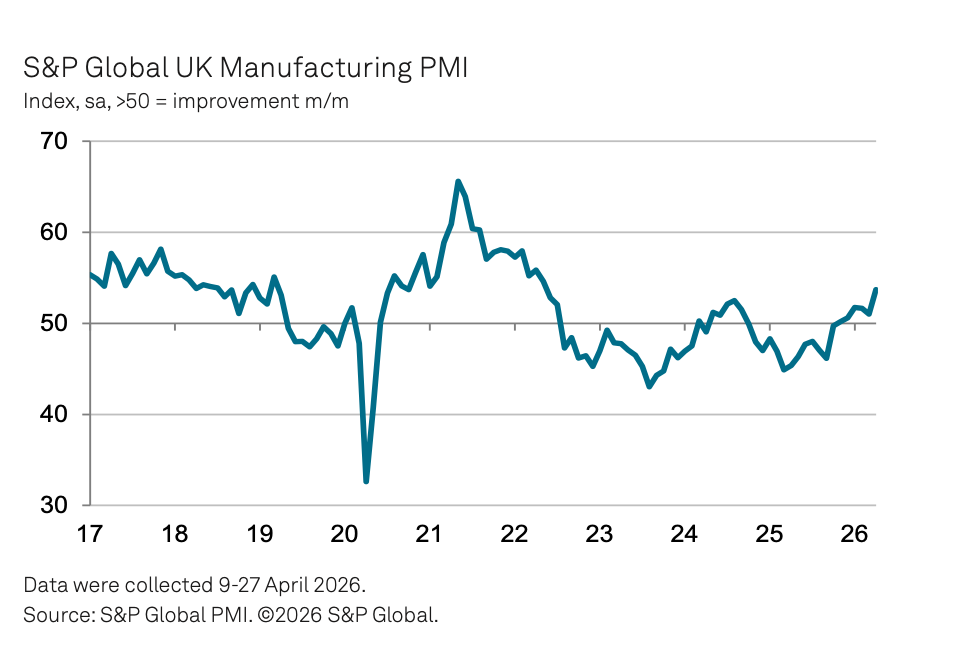
Recent UK manufacturing data suggests conditions within parts of the sector have begun improving again after a prolonged period of inflationary pressure and supply-chain instability. According to the latest S&P Global UK Manufacturing PMI report, manufacturing output, employment, and new orders all showed renewed expansion in April 2026, signaling stronger industrial activity across several high-value sectors.
Life sciences manufacturing has emerged as one of the UK’s strongest-performing industrial categories, attracting significant investment from international pharmaceutical companies and biotechnology firms seeking stable production environments and research partnerships.
Executives at FUJIFILM Corporation noted that the Teesside expansion forms part of a wider global manufacturing strategy intended to strengthen production capabilities across Europe, Asia, and North America. The company stated that over £5 billion has been invested globally over the past decade to scale its contract development and manufacturing operations.
The Teesside facility will also operate in close coordination with Fujifilm’s advanced biomanufacturing site in Toyama, Japan, through the company’s modular “kojoX” production platform. The standardized manufacturing system is designed to improve technology transfer efficiency between international facilities while maintaining quality consistency across multiple production regions.
Analysts believe this type of internationally integrated manufacturing model is becoming increasingly important as pharmaceutical companies seek faster commercialization timelines and greater resilience against future supply-chain disruption.
The investment is also expected to generate substantial regional economic benefits within Northeast England, an area that has increasingly attracted industrial investment tied to renewable energy, chemicals, logistics, and advanced manufacturing. Economic development groups have described the region as one of the UK’s fastest-growing industrial innovation corridors due to its combination of skilled labor availability, port infrastructure, and engineering expertise.
Manufacturing leaders say Britain’s ability to attract projects of this scale will remain essential for sustaining long-term industrial competitiveness. Rising global demand for biologics, AI-assisted drug development, precision medicine, and vaccine manufacturing is expected to create additional opportunities for countries capable of supporting advanced pharmaceutical production ecosystems.
The UK government has meanwhile intensified efforts to position advanced manufacturing as a central pillar of future economic growth. Recent industrial strategy announcements have focused heavily on battery production, clean energy manufacturing, aerospace engineering, semiconductor technologies, and life sciences investment. Officials say strengthening domestic manufacturing capability is critical for improving economic resilience and driving long-term productivity growth. (GOV.UK)
The expansion by FUJIFILM Biotechnologies is increasingly being viewed within the industry as a strong signal that international manufacturers continue to see the UK as a strategically important location for advanced industrial production and scientific innovation.
Investors and sector analysts are also closely watching how Britain’s life sciences sector evolves over the next several years as competition intensifies globally across pharmaceutical manufacturing, biotechnology research, and healthcare innovation.
Despite ongoing challenges linked to energy costs, global inflation, and supply-chain pressures, the UK’s advanced manufacturing sector appears to be regaining momentum through high-value industrial investment and technology-led production expansion.
With biologics demand expected to rise sharply over the coming decade, large-scale investments such as the Teesside expansion are likely to play a major role in shaping the future of British manufacturing and reinforcing the country’s position within the global pharmaceutical supply chain.