
With more than US$605 million in business generated at one of the world’s largest energy events, Brazil’s machinery and equipment sector is strengthening its position within the global oil and gas supply chain.
Trade fairs are often described as showcases of industry. In reality, they are something far more revealing. They are indicators of economic confidence, technological capability, and geopolitical
ambition. Beneath the exhibition booths and formal meetings lies a larger question every country attempts to answer: who will shape the industries of the future?
At the 2026 Offshore Technology Conference in Houston, Brazil’s machinery and equipment industry delivered a compelling response.
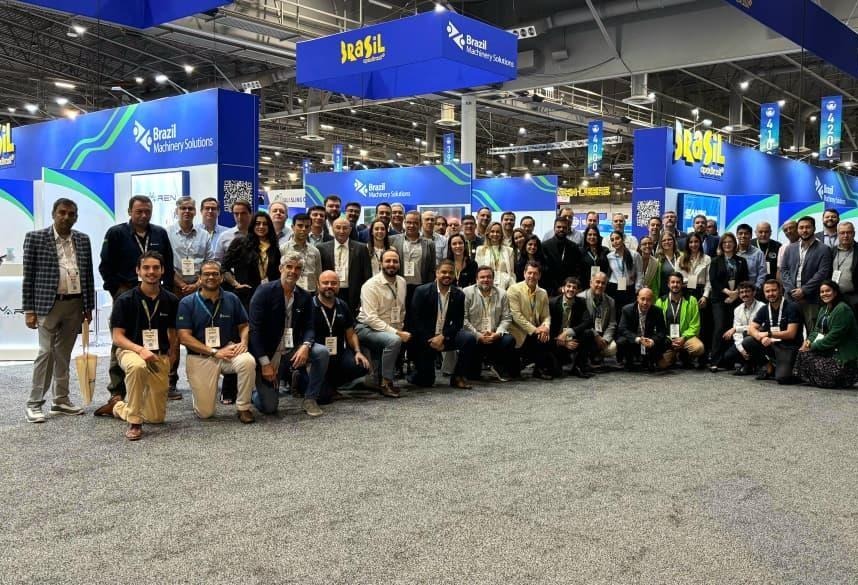
Participating through the Brazil Machinery Solutions initiative, Brazilian companies generated US$605.951 million in business during and following the event, reinforcing the country’s growing influence within the international oil and gas value chain. Of that figure, US$12.581 million was
secured directly during the conference, while an additional US$593.370 million represents projected business expected to materialize over the next year through relationships established and
strengthened during the exhibition.
The scale of engagement was equally significant. The 30 participating Brazilian companies recorded 1,323 business contacts, more than half of them entirely new connections, spanning buyers and
decision makers from 24 countries.
For Brazil’s industrial sector, the results represent more than successful networking. They signal the increasing competitiveness of Brazilian manufacturing in markets traditionally dominated by long
established global suppliers.
The participation was organized through a partnership between ABIMAQ and ApexBrasil, two institutions that have spent years positioning Brazilian industrial capabilities more aggressively within international markets.
OTC itself remains one of the world’s most influential gatherings for the offshore energy sector,
bringing together suppliers, operators, engineering firms, and technology providers connected to both offshore and onshore operations. For companies operating in industrial equipment, automation, logistics, engineering, and digital technologies, visibility at the conference carries strategic value far beyond immediate sales.
According to Patrícia Gomes, the results demonstrate the ability of Brazilian companies to compete within an industry defined by rigorous technical standards and extended commercial cycles.
“The result demonstrates strong commercial conversion capacity and pipeline development at one of the world’s leading energy events,” she noted.
That statement reflects an important reality about the energy industry itself. Large scale oil and gas
projects rarely move quickly. Procurement decisions involve extensive technical evaluation, long term operational reliability assessments, and supply chain scrutiny. In such an environment, trade fairs function less as transactional marketplaces and more as relationship building ecosystems where
future contracts begin to take shape.
Brazil’s presence at OTC highlighted the breadth of capabilities emerging from its industrial sector. Participating companies showcased solutions ranging from automation systems and engineering services to industrial equipment, monitoring technologies, logistics infrastructure, harsh
environment materials, and productivity focused digital tools.
The diversity of contacts established during the event also underscored the expanding global reach of Brazilian manufacturers. Buyers originated not only from the United States, but also from Nigeria,
Argentina, Mexico, Venezuela, and several other international markets. This geographic spread reflects how energy investment patterns are evolving across both developed and emerging
economies, creating opportunities for suppliers capable of adapting to varied operational demands.
For Brazilian companies, such exposure offers strategic advantages beyond immediate deal flow. International engagement allows manufacturers to better understand market specific requirements, identify investment trends, and position themselves earlier within future procurement cycles.
“OTC allows the Brazilian industry to engage with buyers seeking suppliers capable of serving complex operations with high technical requirements,” Gomes explained.
The timing is particularly important.
Global energy markets are undergoing simultaneous transformation and expansion. While renewable energy investments continue accelerating worldwide, oil and gas infrastructure remains central to industrial economies, especially in developing regions where energy demand continues to rise. At
the same time, operators are under pressure to modernize infrastructure, improve operational efficiency, strengthen monitoring systems, and reduce environmental impact.
These shifts are creating growing demand for advanced industrial technologies, precisely the segments where many Brazilian companies are seeking to expand their international presence.
The success of the Brazilian delegation also reflects the broader evolution of Brazil’s industrial identity. Historically recognized primarily for commodities and agriculture, the country has increasingly sought to position itself as a competitive exporter of higher value industrial solutions and capital goods. Programs such as Brazil Machinery Solutions are part of that longer strategic effort to move beyond raw material exports toward technology driven industrial participation within global supply chains.
For sectors like oil and gas, where trust, technical reliability, and long term operational support are critical, sustained international visibility becomes essential. Contracts are rarely won through a single presentation or exhibition appearance. They emerge from years of relationship building, technical
validation, and market presence.
That is why the numbers emerging from Houston matter.
Not simply because they reflect business generated today, but because they signal the strengthening of Brazil’s industrial credibility on the global stage. In industries where complexity defines competition, visibility alone is not enough. Capability must follow.
And increasingly, Brazil’s machinery sector appears determined to demonstrate exactly that.