

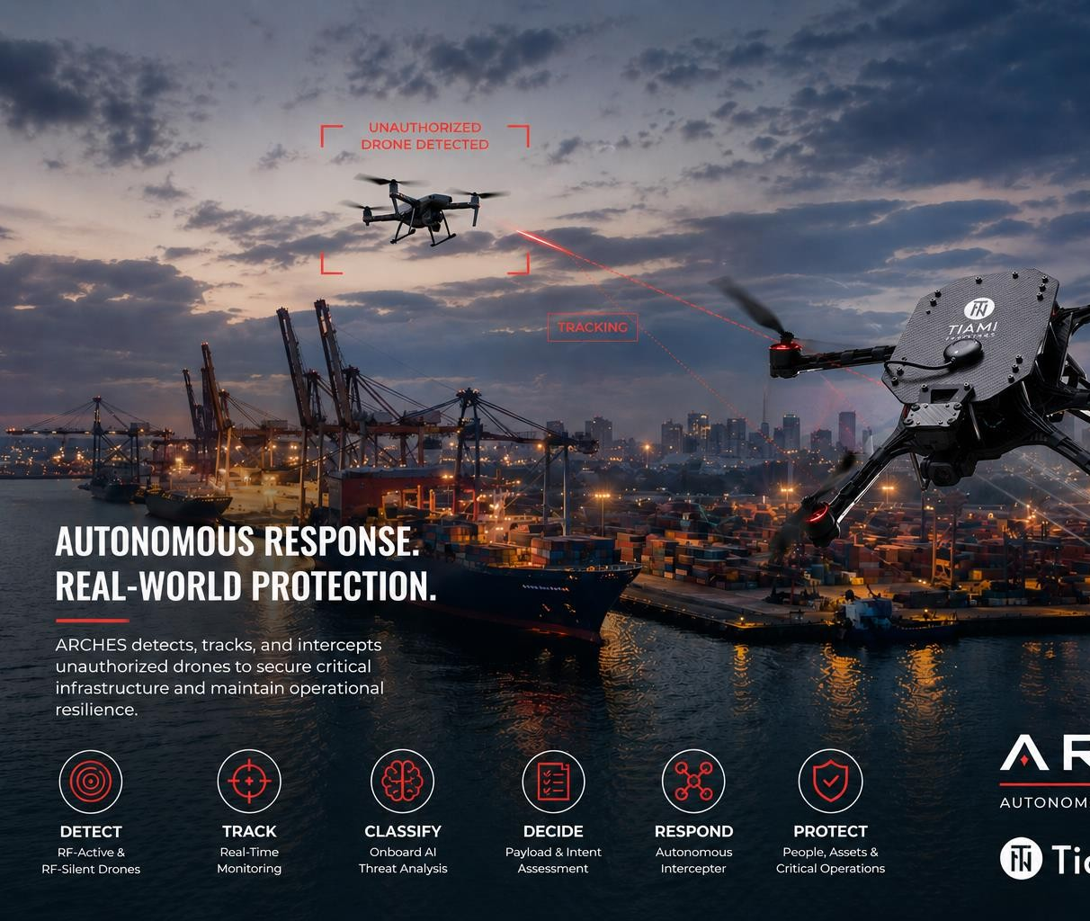

As unmanned aerial threats continue to evolve in speed, sophistication, and accessibility, the pressure on defense and security agencies to respond in real time is intensifying. Addressing that challenge head-on, Tiami Networks has officially launched ARCHES, a next-generation autonomous counter-UAS platform designed to detect, classify, track, and rapidly respond to hostile drone activity.
The company introduced the platform during SOF Week 2026 in Tampa, one of the defense sector’s most closely watched events focused on special operations and emerging battlefield technologies. A live operational demonstration for government stakeholders is scheduled to take place in the Tampa region following the event.
ARCHES — short for Autonomous Response to Change Events — marks a significant expansion of Tiami Networks’ capabilities beyond drone detection and surveillance into autonomous aerial interception and response. The platform has been developed for military operations, homeland security missions, border protection, and critical infrastructure defense, sectors where the growing use of drones has created both operational opportunities and increasingly complex security risks.
The launch comes at a time when low-cost unmanned systems are reshaping modern conflict and security planning. Commercially available drones, modified aerial platforms, and autonomous reconnaissance systems are now routinely being deployed in contested environments, creating a need for defense systems capable not only of identifying threats, but neutralizing them within seconds.
Tiami Networks positions ARCHES as a system built specifically for that reality.
“Drone threats are becoming faster, cheaper, and more adaptive, while many response systems remain too slow or too limited,” said Amitav Mukherjee, Chief Executive Officer of Tiami Networks. “ARCHES gives operators a new option — autonomous, intelligent, and built for real-world environments.”
At the core of the platform is an AI-enabled workflow engineered for rapid decision-making under operational pressure. The system follows a layered process that includes aerial threat detection, real-time tracking and classification, onboard AI evaluation of payloads and intent, response recommendation generation, and autonomous interception execution.
Unlike traditional counter-drone systems that primarily focus on detection and electronic disruption, ARCHES has been designed to transition operators from awareness to active response with minimal delay.
The baseline ARCHES Interceptor is engineered for high-speed aerial engagement, with reported speeds approaching 100 miles per hour. The platform incorporates onboard AI processing, optical capabilities for day and night operations, and autonomous maneuverability intended to support dynamic engagement environments.
One of the more technically notable aspects of the platform is its ARCHES Fiber Variant — a specialized RF-silent configuration created for contested electromagnetic environments where jamming, spoofing, and signal detection pose operational risks.
Rather than relying solely on conventional wireless command systems, the fiber-controlled variant uses a fiber optic tether for command-and-control, telemetry, and HD video transmission while maintaining zero RF emissions. This design approach offers resilience in environments where electronic warfare capabilities may compromise conventional drone systems.
The architecture also reflects broader defense industry trends toward layered and integrated sensing ecosystems. ARCHES can operate independently or integrate into Tiami Networks’ wider sensing and intelligence infrastructure, including the company’s PolyEdge platform.
This layered approach is becoming increasingly important as defense agencies shift from isolated hardware solutions toward interconnected autonomous systems capable of sharing intelligence across multiple domains.
Tiami Networks says the platform is immediately available for demonstrations, pilot deployments, and government evaluation programs, signaling an aggressive push into a rapidly expanding counter-UAS market.
The global counter-drone industry has seen accelerated investment over the past several years as governments and critical infrastructure operators seek solutions for airports, energy facilities, military bases, public venues, and border security operations. The challenge has grown more urgent as unmanned systems become harder to detect, cheaper to deploy, and increasingly autonomous.
Against that backdrop, ARCHES enters the market not simply as a detection platform, but as an operational response system designed around speed, autonomy, and adaptability.
“We believe the future of counter-UAS is integrated sensing paired with rapid response,” Mukherjee added.
With autonomous aerial threats continuing to redefine modern security environments, systems like ARCHES illustrate how the next phase of defense technology is shifting toward intelligent, real-time response capabilities that reduce reaction windows from minutes to seconds.