

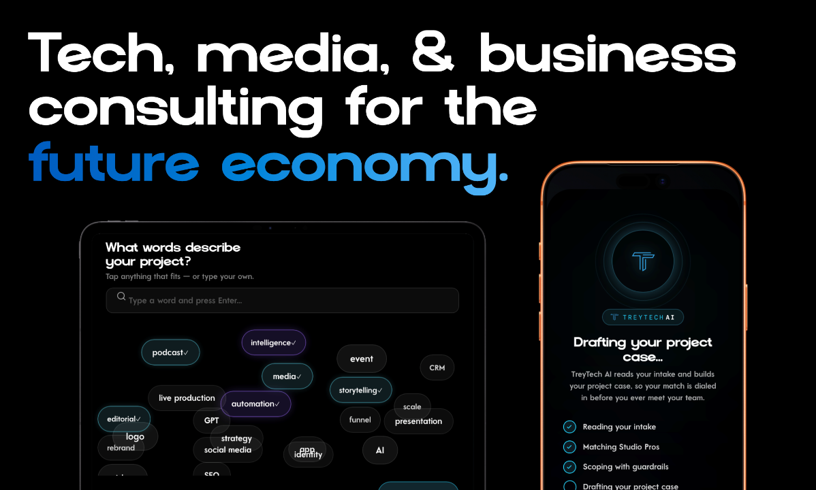

Dallas-based TreyTech is repositioning consulting as a human-led, AI-enabled platform business—combining five specialist studios, a vetted creator network, and a single-point-of-contact engagement model designed to serve everyone from local entrepreneurs to enterprise clients
TreyTech is stepping into its next chapter with an ambitious proposition: to reimagine consulting for an economy increasingly shaped by artificial intelligence, creator-led work, and platform-driven business models. Headquartered in the Dallas-Fort Worth metroplex, TreyTech Studios LLC has introduced a consulting ecosystem that blends human expertise with AI-powered execution, positioning itself as a technology, media, and business consulting platform for what it calls the “future economy.”
The company’s new structure is built around five interconnected studios—Brand, Content, AI Transformation, Digital, and Experience—supported by a vetted network of specialists known as Studio Pros. Rather than operating as a conventional agency, freelancer marketplace, or hourly consulting firm, TreyTech says it intends to function as a managed platform: matching clients with the right expertise, overseeing delivery from concept to completion, and maintaining quality control through a single engagement lead.
At the heart of TreyTech’s pitch is a view that consulting has become overly fragmented and impersonal. “The platforms that reshaped the world were not built by owning everything,” the company said in announcing its next phase. “Uber did not own the cars. Airbnb did not own the homes. They worked because they created trust, set standards, and connected people to the right resources at the right time. That is the future of consulting.”
That framing is central to TreyTech’s identity. The company argues that while the broader consulting and creative services market has become more transactional, clients still need strategic guidance, accountability, and a trusted partner who can manage complexity without losing the human dimension of the work. TreyTech’s answer is a platform model that keeps a real person at the center of every engagement while using AI to increase speed, efficiency, and scale.
A consulting platform, not a conventional agency
TreyTech is explicit about what it is not. It does not describe itself as an agency with a fixed in-house bench, nor as an open marketplace where clients browse profiles and hope the right match emerges. It also distances itself from the classic consulting model of generalist teams and billable-hour structures.
Instead, the company is presenting a more curated, integrated operating model. Clients begin with a creative consultation and are then assigned a dedicated Engagement Manager who oversees the project across its lifecycle. Behind the scenes, TreyTech assembles the appropriate Studio Pros across its five practice areas, depending on the brief.
The structure is intended to remove friction for clients while preserving specialist depth. Rather than forcing customers to coordinate across separate agencies, freelancers, software vendors, and advisors, TreyTech wants to offer a single interface through which branding, content, digital buildouts, AI implementation, events, and growth consulting can be executed in a coordinated way.
Its five studios reflect that ambition. Brand Studio focuses on identity, positioning, naming, and messaging. Content Studio covers editorial, video, social content, and reputation-building systems. AI Transformation Studio is designed around workflow automation, intelligent systems, and responsible AI deployment, with TreyTech noting that the practice is being built by practitioners who have shipped AI systems in Fortune 500 environments. Digital Studio spans websites, applications, infrastructure, performance, search, and growth systems, while Experience Studio handles events, activations, and immersive brand experiences.
Together, the studios form what TreyTech is positioning as a modular but connected consulting environment—one capable of serving a broad spectrum of needs without asking clients to manage the seams themselves.
AI as an accelerator, not a substitute for human judgment
In a market saturated with AI claims, TreyTech is leaning into a nuanced message: AI should enhance human capability, not displace it. The company repeatedly frames itself as “AI-forward, human-first,” making that principle one of the defining pillars of its relaunch.
“Here is the part everyone is anxious about, so let us say it plainly,” the company said. “The world is racing into AI. We are racing too, but on purpose.”
TreyTech says AI will be embedded into every engagement to improve speed, scalability, and possibility, but insists that responsibility, taste, strategic judgment, and accountability remain firmly human. “We count on people for taste, judgment, accountability, and heart,” the company said. “The goal was never to replace your team or ours. It is to give them superpowers.”
That stance reflects a broader shift taking place across consulting and creative industries, where firms are under pressure to adopt AI without hollowing out the very expertise clients pay for. TreyTech appears to be betting that the next generation of consulting demand will favour operators who can implement AI responsibly while retaining a premium on human curation, governance, and execution.
It is also making a point of tying AI deployment to ethical safeguards. “A real person is always accountable for the outcome,” the company said. “AI makes us faster and sharper. It never replaces responsibility.”
A model designed to serve both local clients and enterprise accounts
One of the more distinctive aspects of TreyTech’s strategy is the breadth of client segments it intends to serve. The company is not confining itself to one tier of the market. Instead, it is pitching the same platform architecture to local families and individuals, emerging creators and small businesses, and large organizations pursuing transformation agendas.
For local Dallas-Fort Worth clients, TreyTech envisions services such as branded invitations, graduation announcements, event creative, or foundational brand work for small businesses. For growth-stage companies and creators, the offering expands to include content systems, websites, funnels, brand strategy, and AI workflows. For enterprise and institutional clients, the proposition becomes more transformation-oriented: AI adoption, ERP modernization, digital transformation, and multi-studio consulting engagements.
The commercial rationale is clear. By designing a flexible delivery model rather than a narrowly defined service line, TreyTech is attempting to capture work across multiple budget levels and business maturities while maintaining a consistent quality threshold. The challenge, of course, will be execution—ensuring that a platform built to serve both a family event brief and a Fortune 500 transformation project can sustain credibility at both ends of the spectrum.
Community as strategy, not an add-on
TreyTech’s expansion is not limited to client services. The company is also building a broader ecosystem around its consulting platform, one that includes a creator network, open educational programming, community support initiatives, and launch partnerships.
The Studio Pro Network will serve as TreyTech’s vetted pool of professionals across all five studios, including designers, developers, writers, strategists, AI specialists, and producers. The company says the network will be built around fixed-fee work, creator-owned intellectual property, and a structure that allows professionals to retain ownership of what they make.
That emphasis on ownership and creator protection is a recurring theme in TreyTech’s messaging. The company says it wants to create an environment where creatives can focus on their craft without being forced to surrender their rights or navigate exploitative contractual structures. “The people who do that work should not have to choose between their craft and their livelihood,” TreyTech said.
Alongside the professional network, TreyTech is also launching Open Studio, a free public-facing forum where participants can join live sessions, discuss ideas, and receive feedback from Studio Pros and invited industry voices. The first session is tentatively scheduled for August 7, 2026. Studio Supports, meanwhile, will function as TreyTech’s giveback initiative, offering creative and technical support to nonprofit, faith-based, educational, and community organizations, with particular attention to performing arts, children’s programming, and technology access.
The business case for this ecosystem strategy is significant. In an increasingly crowded consulting market, community can function as both a talent engine and a brand moat. It creates a pipeline of future collaborators, deepens loyalty, and gives the company a narrative that extends beyond transactions. TreyTech appears to understand that the long-term value of its platform may lie as much in the strength of its network as in the projects it delivers.
A platform bet on where consulting is headed
TreyTech’s relaunch is, in many ways, a wager on the future shape of consulting itself. It assumes that clients want specialist capability without the fragmentation of managing multiple vendors; that creators want flexible, well-paid work without sacrificing ownership; and that AI’s true commercial value will be unlocked not by replacing people, but by equipping them to do more sophisticated work, more efficiently.
Whether TreyTech can fully execute on that vision remains to be seen. Building a platform that balances high-touch service, multi-disciplinary consulting, creator protection, and AI-enabled delivery is a complex undertaking. Yet the proposition is timely. As enterprises rethink transformation budgets, smaller businesses seek affordable strategic support, and creative professionals look for more equitable ways to work, the consulting industry is clearly in flux.
TreyTech is trying to meet that moment with a model that feels part consultancy, part managed marketplace, and part creative-tech community. If it can deliver on the promise of being both “AI-forward” and “human-first,” it may carve out a compelling niche in a sector that is rapidly being rewritten by technology, talent mobility, and changing client expectations.