

The software engineering company said its new AI native SDLC embeds artificial intelligence across the delivery lifecycle while retaining human oversight, governance and quality controls.
Austin, Texas: Software development is entering a new phase in which artificial intelligence is becoming part of the engineering process itself rather than simply an additional productivity tool. Leobit is positioning itself for that transition with the introduction of an AI native software development lifecycle, designed to help organizations accelerate product delivery while maintaining experienced human oversight.
The company’s approach integrates AI across requirements gathering, solution design, engineering, testing, release management and project coordination. Rather than allowing AI tools to operate in isolation, the model is built around governed workflows, shared engineering context and measurable quality controls.
Leobit said the approach has already produced significant improvements across client projects, with some engagements achieving between three and ten times faster time to accepted output compared with traditional development methods.
“Our projects are already achieving 3 to 10x faster time to accepted output compared with traditional development,” said Oleksa Stelmakh, Founder and CEO of Leobit. “It’s a smarter, faster, and more reliable way to build software in an AI driven world.”
The announcement reflects a broader transformation within the company. Over the past year, Leobit has expanded its AI capabilities beyond software development to include AI readiness assessments, discovery workshops, corporate large language models, AI agents and multi agent systems.
For organizations exploring how emerging technologies are reshaping enterprise operations and product development, more insights into the global technology landscape are available at www.worldecomag.com.
Moving Beyond AI Assisted Development
The distinction between AI assisted and AI native development is becoming increasingly important.
AI assisted development generally uses intelligent tools to support individual tasks such as code generation or testing. An AI native SDLC, by contrast, embeds AI into the wider operating model of software delivery. Engineers, architects, QA specialists, business analysts and project managers work alongside AI systems while retaining responsibility for direction, validation and final decisions.
Leobit has also invested in internal training and certifications to prepare employees for these changing roles. The company said it has replaced static project templates with AI powered alternatives and introduced AI driven code reviews using Anthropic’s Claude.
Key Highlights
- AI integrated across the full software development lifecycle
- Human oversight and engineering governance retained throughout delivery
- Reported client project gains of 3 to 10 times faster accepted output
- AI transformation services spanning assessment, implementation and scaling
- Expanded expertise across Microsoft Azure and Anthropic technologies
- Security controls designed for enterprise and regulated data environments
Supporting Different Stages of AI Adoption
Leobit’s strategy recognizes that companies are approaching AI from very different starting points.
For businesses still evaluating the technology, the company offers assessments and discovery processes intended to identify practical use cases before major investments are made. Organizations ready to implement AI can work with Leobit on corporate LLMs, intelligent automation, AI agents and multi agent systems.
Companies with existing AI initiatives can focus on scaling. This includes embedding AI more systematically into engineering workflows, governance structures and delivery processes.
Security remains a central consideration, particularly for enterprises handling confidential information. Leobit said its solutions can be deployed on infrastructure such as Azure AI services, allowing systems to operate where client data already resides. Its approach also incorporates measures including automated data masking, role based access controls and governance rules.
The company is backed by ISO 27001:2022 and ISO 9001:2015 certifications.
Building on Strategic Partnerships
Leobit has also continued to strengthen its technology ecosystem through its work with Microsoft and Anthropic. The company added the Microsoft Solutions Partner for Data & AI designation to its existing Microsoft relationship and has expanded its Anthropic expertise through certified architects and engineers.
These partnerships are intended to support the company’s wider push towards enterprise grade AI implementation, combining cloud infrastructure, foundation models and engineering expertise.
As businesses move from experimentation to more structured AI adoption, software delivery itself may become one of the most significant areas of transformation. The challenge will not simply be generating code faster. It will be building governance, security, quality assurance and human accountability into increasingly intelligent development environments.
Leobit’s AI native SDLC is its response to that challenge, positioning AI as an integrated part of the engineering system rather than an external tool added to the workflow.
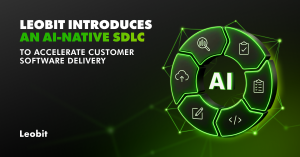
Image caption: Leobit’s AI native software development lifecycle integrates artificial intelligence across the software delivery process while maintaining human oversight and engineering governance.
External link: www.leobit.com
Digital Hive Brings a New Skills Infrastructure to Europe’s Creative Economy
Image caption: The DigiCreate Digital Hive Toolbox brings together digital tools, learning resources and collaboration features to help young creatives and educators build skills for Europe’s evolving cultural and creative industries.
The cultural and creative industries are being reshaped by digital technology, but access to the right skills remains uneven. For young creatives in particular, talent alone is increasingly insufficient. Digital content creation, online communication, project management, marketing and collaboration have become essential parts of building sustainable creative careers.
A new European initiative is seeking to close that gap.
The DigiCreate Empower project, funded through the European Union’s Erasmus+ programme, has launched the DigiCreate Digital Hive Toolbox, an online resource platform designed to help young creatives, educators and youth workers develop practical digital capabilities. The initiative targets users aged 18 to 30 across Europe and the Western Balkans, while also creating opportunities for cross border collaboration and professional networking.
The toolbox forms part of the broader DigiCreate Digital Platform and is intended to function as a practical digital skills ecosystem rather than simply another online library of educational content.
Building Digital Confidence for Creative Careers
The need for such infrastructure is becoming increasingly apparent across the Cultural and Creative Industries, where professional opportunities are often closely linked to an individual’s ability to work across digital platforms.
The Digital Hive Toolbox brings together curated digital tools, educational resources, user guides and supporting materials covering areas ranging from graphic design and video editing to audio production, interactive storytelling and project management.
Users can explore the public overview of the toolbox before registering. Those who create a free DigiCreate account gain access to the complete collection and the platform’s wider community features.
A structured search and filtering system is designed to make the growing library easier to navigate. Registered users can filter resources according to type, category and functionality, or search by keyword and consortium partner.
The categories include professional development, productivity, knowledge resources, collaboration, self assessment and e learning. Individual tool profiles provide standardised information about each resource, including its purpose, contributing organisation, pricing model, relevant creative sectors and typical users.
That level of organisation could prove particularly useful for young professionals who are often faced with an overwhelming number of digital platforms but lack the time or expertise to determine which ones are genuinely relevant to their work.
Beyond Tools, a Creative Community
DigiCreate’s ambitions extend beyond digital skills training.
Registered members can participate in an online community designed around peer learning, networking and collaboration. The platform includes an events calendar covering workshops, virtual exchanges and other activities, alongside a forum where members can exchange ideas and experiences.
A community wall allows participants to share reflections and feedback, while a searchable member directory and interactive community map are intended to make it easier to identify potential collaborators across different countries.
This cross border dimension is particularly relevant to the creative economy. Designers, filmmakers, musicians, digital storytellers, educators and other creative professionals increasingly work across geographic boundaries, often building project teams and professional networks that span multiple markets.
By bringing these functions together with practical digital resources, DigiCreate is attempting to address both sides of the challenge: developing individual capability while creating the networks through which that capability can be applied.
A Pan European Partnership
The project is supported by a consortium of eight organisations from Germany, Spain, Portugal, Serbia, Bosnia and Herzegovina and Montenegro. The partners bring experience spanning youth work, education, technology, cultural management and project implementation.
The initiative is also notable for its emphasis on the European and Western Balkan creative ecosystem. Rather than treating digital skills as an isolated educational issue, the project connects them to employability, entrepreneurship, collaboration and participation in the wider creative economy.
For Europe, where the cultural and creative industries represent an important source of employment, innovation and cultural expression, strengthening digital capability among younger generations could have implications well beyond individual career development.
The DigiCreate Digital Hive Toolbox is now available through the project’s online platform, with the public overview accessible at:
Young creatives, educators and youth workers can register for full access at:
The wider DigiCreate platform can be explored at:
As the creative economy becomes increasingly digital, the ability to create is only one part of the equation. Knowing how to communicate, collaborate, manage projects, reach audiences and navigate digital tools is becoming equally important.
Initiatives such as DigiCreate suggest that the next generation of creative talent will need not only imagination, but also the digital infrastructure and professional networks required to turn that imagination into sustainable opportunity.
For more coverage of technology, education, innovation and the future of work, visit www.worldecomag.com.
External source: https://digicreate-empower.eu/
Digital Hive Toolbox: https://digicreate-empower.eu/hive-toolbox/