


The United Kingdom’s artificial intelligence sector is witnessing accelerated momentum as Google DeepMind continues expanding its research footprint in advanced machine learning systems, scientific discovery models, and next-generation AI safety frameworks. The company’s latest research direction reflects the UK’s growing importance as a global hub for frontier AI development, particularly in foundational models, scientific computing, and responsible AI governance.
Headquartered in London, DeepMind remains one of the world’s most influential AI research organizations, with breakthroughs spanning reinforcement learning, protein structure prediction, multimodal systems, and large-scale reasoning models. The company’s continued expansion into scientific and applied AI research is reshaping how artificial intelligence is deployed across healthcare, energy systems, materials science, and advanced engineering domains.
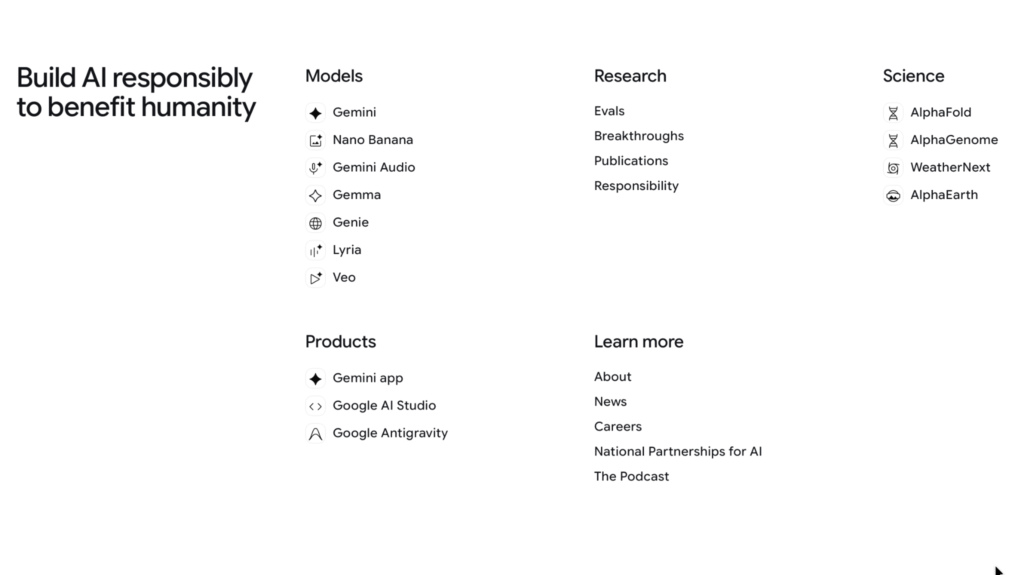
Recent updates from Google DeepMind highlight ongoing progress in building more capable and generalizable AI systems designed to assist in complex problem-solving tasks. These advancements include improvements in model reasoning ability, efficiency optimization, and multi-domain learning performance, enabling AI systems to operate across increasingly diverse scientific and industrial environments.
Source: deepmind.google
Industry experts say the UK’s AI ecosystem has become one of the most strategically important globally due to the concentration of leading research institutions, strong academic partnerships, and government-backed innovation policies. London, in particular, has emerged as a major AI research and talent hub, attracting global investment from technology firms seeking proximity to cutting-edge research and regulatory frameworks.
DeepMind has played a central role in shaping modern AI development standards, especially in areas related to model safety, interpretability, and alignment. The company’s research teams continue to focus on ensuring that increasingly powerful AI systems remain controllable, transparent, and aligned with human intent—an area widely considered critical as AI capabilities expand rapidly.
One of the key focus areas for the company is the application of AI in scientific discovery. DeepMind’s research has already demonstrated significant breakthroughs in biology and chemistry, including protein folding prediction systems that have transformed structural biology research worldwide. These innovations are now being extended into drug discovery, climate modeling, and materials engineering.
The UK government has simultaneously intensified efforts to strengthen its position in global AI governance and innovation. Recent policy frameworks emphasize safe AI deployment, investment in compute infrastructure, and partnerships between academia and industry. These initiatives are designed to ensure that Britain remains competitive in the global race for AI leadership while maintaining strong ethical and regulatory standards.
At the same time, global competition in artificial intelligence continues to intensify, with major technology companies across the United States, China, and Europe investing heavily in foundational AI models and computing infrastructure. However, the UK’s advantage lies in its research depth, strong regulatory ecosystem, and established leadership in AI safety research—areas where DeepMind continues to play a defining role.
Recent industry analysis suggests that enterprise adoption of AI is accelerating across sectors such as healthcare, finance, logistics, defense, and education. AI systems are increasingly being integrated into decision-support tools, predictive analytics platforms, and automation systems, enabling organizations to improve efficiency, reduce costs, and enhance operational accuracy.
DeepMind’s research also reflects a broader shift toward multimodal AI systems capable of processing and understanding text, images, audio, and scientific data simultaneously. These systems are expected to become foundational for next-generation applications in robotics, autonomous systems, and advanced simulation environments.
In parallel, AI safety and governance remain central to the UK’s technology agenda. Researchers at DeepMind and partner institutions continue to explore methods for ensuring that AI systems remain robust, fair, and aligned with human values as they become more autonomous and widely deployed.
The company’s London-based research teams are also collaborating closely with global academic institutions to advance understanding of large-scale AI systems, including how they learn, generalize, and make decisions. These collaborations are helping to shape international standards for AI development and evaluation.
Despite rapid progress, experts caution that challenges remain in scaling AI responsibly. Issues such as data bias, computational cost, energy consumption, and regulatory fragmentation continue to shape the global AI landscape. Policymakers and researchers alike are emphasizing the importance of coordinated global frameworks to manage the societal impact of advanced AI systems.
Nevertheless, the long-term outlook for AI innovation in the UK remains strong. With sustained investment, strong academic-industry collaboration, and world-leading research institutions like DeepMind, the country is expected to remain at the forefront of artificial intelligence development throughout the next decade.
As AI systems continue evolving from narrow task-based tools to more general-purpose intelligence platforms, the role of foundational research organizations will become increasingly critical. DeepMind’s continued advancements highlight not only the UK’s leadership in AI research but also its growing influence in shaping the future global standards for artificial intelligence development and deployment throughout 2026 and beyond.