

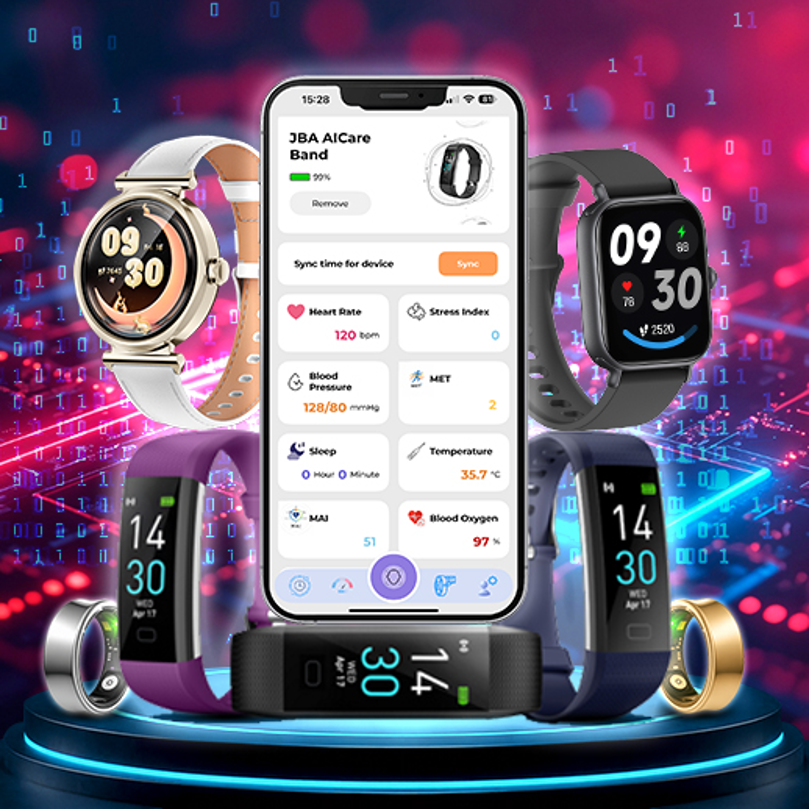

AQP One has introduced BioBaseline™, a proprietary modeling framework designed to strengthen its JBA AICare™ platform by interpreting long-term physiological patterns across metabolic, cardiovascular, sleep, stress and recovery domains rather than relying on isolated biometric readings
As digital health moves deeper into the age of wearables, remote monitoring and AI-assisted wellness platforms, one question is becoming increasingly important: what does all that data actually mean for the individual generating it? AQP One believes the answer lies not in collecting more numbers, but in learning how to interpret them in context. With that premise, the US-based health technology company has formally introduced BioBaseline™, a proprietary physiological modeling framework that it says will serve as a foundational layer in its expanding JBA AICare™ Physiological Intelligence Platform.
The launch marks the latest step in AQP One’s effort to build a more integrated wellness intelligence ecosystem spanning metabolic, cardiovascular, sleep, stress and recovery signals. It follows the company’s recent expansion of JBA AICare™ into metabolic and GLP-1 trend intelligence, and signals a broader ambition to move beyond the fragmented world of point-in-time biometrics toward a longitudinal, more personalised model of health interpretation.
In practical terms, AQP One is trying to address a structural limitation in much of today’s wearable and digital health landscape. Most devices are adept at generating readings—heart rate, sleep duration, glucose trends, stress scores, recovery markers—but less effective at answering a more meaningful question: whether a given number represents stability, progress or concern for that specific person over time. A reading that appears normal against a population benchmark may, in fact, signal a notable shift for an individual whose physiology usually behaves differently. BioBaseline™ is designed to interpret those subtleties.
Building a personal reference point for health data
At the centre of AQP One’s thesis is the idea that physiological intelligence must begin with the individual, not the average. BioBaseline™ is intended to create a personalised reference framework for each user by continuously learning their biological patterns and mapping directional shifts against that evolving baseline. Rather than treating health metrics as isolated snapshots, the system is built to analyse how a person’s signals move over time and across multiple domains.
The company says the framework focuses on several core dimensions: pattern stability over time, directional physiological drift, variability relative to an individualised baseline, and cross-domain correlations linking metabolic, cardiovascular, sleep, stress and recovery signals. In other words, the objective is not simply to record a metric, but to understand its significance in relation to the user’s broader physiological trajectory.
This matters because two people can present similar numbers while moving in very different biological directions. A heart-rate pattern, a sleep score or a metabolic reading that appears unremarkable in a general population model may reflect a meaningful change for one person and a stable pattern for another. AQP One’s argument is that the future of health intelligence will depend on systems capable of distinguishing between those two realities.
“Data alone does not create intelligence,” said Tracy (Trang) Nguyen, founder of AQP One. “BioBaseline™ represents our effort to shift from measuring numbers to understanding biological direction.”
From data collection to physiological interpretation
That distinction—between data collection and interpretation—sits at the heart of AQP One’s strategy. The digital health market is expanding rapidly, with wearable technologies, AI-enabled health applications and remote monitoring tools becoming increasingly mainstream. Yet as the market matures, the competitive edge may no longer rest with the companies that gather the greatest volume of data, but with those able to convert that data into useful, contextual and personalised insight.
AQP One is positioning BioBaseline™ as precisely that kind of interpretive layer. Integrated across the JBA AICare™ ecosystem, the framework is designed to work with signals collected over time through compatible sensors, wearable devices and smartphone-based assessments. The company describes it as a modelling architecture that helps users make sense of longitudinal trends across wellness domains, rather than a tool for delivering one-off biometric scores.
Importantly, AQP One is careful to frame the platform within a wellness context rather than a diagnostic one. The company says BioBaseline™ is intended to support earlier awareness through trend interpretation and that all outputs remain estimated wellness-focused indicators. They are not intended to diagnose, treat, cure or prevent disease. That distinction is significant in a health-tech environment where companies must carefully navigate regulatory boundaries between consumer wellness tools and medical devices.
Still, the company is clearly thinking at the edge of preventive health. As artificial intelligence becomes more deeply embedded in wellness and clinical technologies alike, personalised baseline modelling could become an increasingly valuable tool for identifying subtle shifts before they escalate into more serious problems—or at the very least, for giving users a more meaningful understanding of how lifestyle, recovery, sleep or metabolic changes are affecting them over time.
The architecture behind AQP One’s broader platform vision
BioBaseline™ is not being introduced as a standalone product so much as the core modelling architecture behind AQP One’s larger platform ambitions. The company views it as the connective tissue linking multiple areas of physiological intelligence into one more coherent system of personalised interpretation.
That vision is embodied in JBA AICare™, AQP One’s health technology platform, which combines AI-enabled interpretation, BioBaseline™ modelling, smartphone-based assessments and compatible wearables. In the United States, the platform is registered within the FDA medical device system, while in Vietnam it has been classified as a Class B medical device under local regulations—signals that the company is seeking credibility across both consumer wellness and more formal healthcare-adjacent settings.
Nguyen’s own story adds a layer of human depth to the company’s narrative. Nearly five decades ago, she arrived in the United States as a Vietnamese refugee. Trained as both an electrical engineer and chemist at the University of Minnesota, she founded AQP One with what the company describes as a long-term vision grounded in resilience, science and purpose.
“You only live once—make it count,” Nguyen said. “BioBaseline™ is our step toward building physiological intelligence so people can better understand and protect life.”
That framing captures the aspiration behind the launch. AQP One is not merely introducing another wellness feature; it is trying to redefine the logic by which digital health platforms understand the body. If most consumer health tools have so far focused on showing people what their numbers are, BioBaseline™ represents an attempt to answer a more sophisticated question: what do those numbers mean for you, specifically, over time?
In an increasingly crowded health-tech market, that may prove to be a meaningful distinction.