

As labor costs climb and passenger traffic rebounds across Europe, AI-powered vending systems are transforming railway stations and metro concourses into data-driven, always-on retail ecosystems
Europe’s transit retail economy is entering a new phase of automation. Across major railway stations, metro interchanges, and airport terminals, operators are rethinking how commercial space is monetized as rising labor costs collide with surging passenger volumes and shifting consumer expectations. What was once a landscape dominated by staffed kiosks, bakery counters, and convenience chains is increasingly being reshaped by intelligent, self-operating retail systems capable of serving travelers around the clock.
The transformation is less about novelty than economics. Station landlords and transit authorities are under pressure to maximize revenue per square meter while maintaining service continuity during late-night and off-peak hours when traditional concessions often struggle to remain profitable.
Automated retail formats — powered by robotics, AI, IoT telemetry, and contactless payment systems — are emerging as an operational solution to those pressures. Industry analysts have noted that unattended retail has become one of the fastest-growing segments within European transit commerce. The appeal lies in the model’s efficiency. Unlike conventional food and beverage outlets, robotic retail units operate with minimal staffing overhead, require smaller footprints, and generate revenue continuously without the scheduling constraints associated with human labor.
At the center of this shift is the evolution of vending itself. The traditional image of a machine dispensing packaged snacks through a spiral coil mechanism has become outdated. Today’s AI- enabled systems are capable of preparing food and beverages on demand, monitoring inventory in real time, conducting predictive maintenance diagnostics, and delivering highly customized consumer experiences.
In operational terms, many of these units resemble compact automated restaurants more than vending machines. They assemble products fresh, record transactional data down to SKU level, and integrate seamlessly into digital payment ecosystems. For transit operators, the value proposition is compelling: a retail solution that occupies minimal space while functioning continuously in high-density commuter environments.
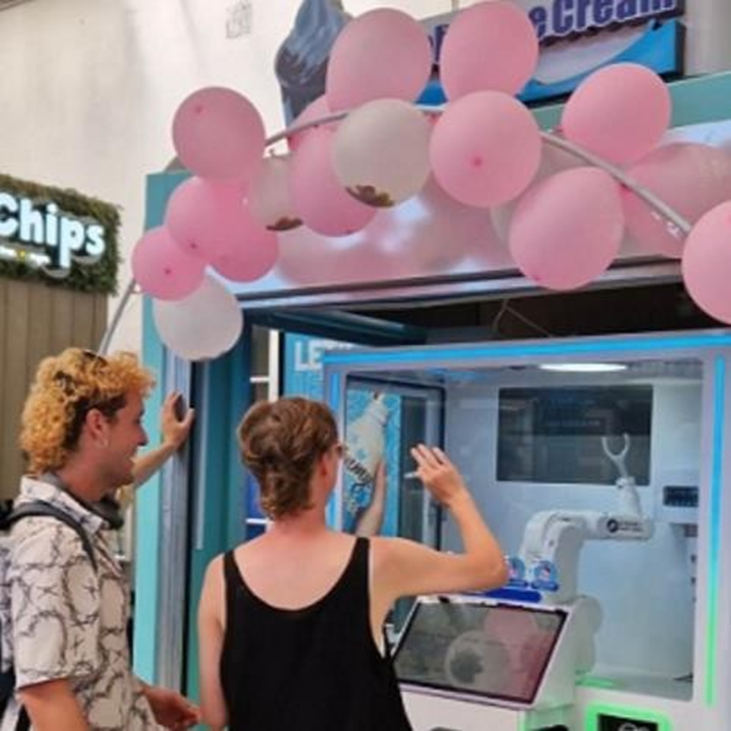
One of the clearest examples of this trend recently emerged at Birmingham New Street station in the United Kingdom. A robotic sundae kiosk developed by Chinese automation company Anno Robot was installed inside the station concourse, marking the company’s first deployment within a British transit hub. The enclosed system uses a robotic arm to prepare customized ice cream sundaes in under 30 seconds, handling everything from dispensing soft serve to applying sauces and toppings.
The installation reflects a broader strategic shift in transit retail management. During peak commuting periods, queues at traditional food outlets can disrupt pedestrian circulation within stations. Automated units help absorb impulse demand without increasing congestion or requiring additional personnel. More importantly, they continue operating long after conventional concessions close, generating incremental revenue during low-traffic hours that previously produced limited commercial return.
What transit operators are effectively purchasing is not simply a food product, but a set of operational advantages. Continuous service availability, reduced dependency on labor, lower spatial requirements, and detailed consumer data collection have become the defining attractions of automated retail infrastructure.
Data, in particular, may prove to be one of the category’s most valuable long-term assets. Every transaction conducted through a robotic retail unit generates structured behavioral information, offering operators deeper visibility into passenger purchasing habits, dwell times, peak traffic periods, and product preferences. As concession models evolve, these analytics capabilities are increasingly influencing how lease agreements are structured and valued.
The growth trajectory closely mirrors the earlier rise of robotic coffee systems, which moved from novelty concepts in Asian malls to mainstream fixtures in European airports, universities, and office complexes within a few years. That category demonstrated a crucial principle: consumers are willing to embrace machine-prepared products when quality remains consistent, customization options are meaningful, and service times are predictable.
Yet the next competitive battleground may not be hardware sophistication alone. Increasingly, success depends on localization and backend reliability. Consumer preferences differ sharply across European markets, from sweetness profiles and portion sizes to beverage strength and flavor combinations. Operators capable of tailoring menus to regional tastes while maintaining rapid service networks and predictive maintenance systems are likely to dominate the sector.
The implications extend beyond food and beverage. As automated retail systems become more sophisticated, transit hubs may evolve into highly dynamic, data-driven commercial ecosystems where retail formats can be adjusted in near real time based on passenger behavior patterns.
For station operators, the strategic question is no longer whether automated retail belongs inside modern transit environments. The question is how quickly these systems can be integrated, which categories will scale most effectively, and how concession economics must evolve in an era where robotic systems can generate revenue continuously, even at three o’clock in the morning. The stations that adapt fastest may well define the future of urban transit commerce across Europe.