



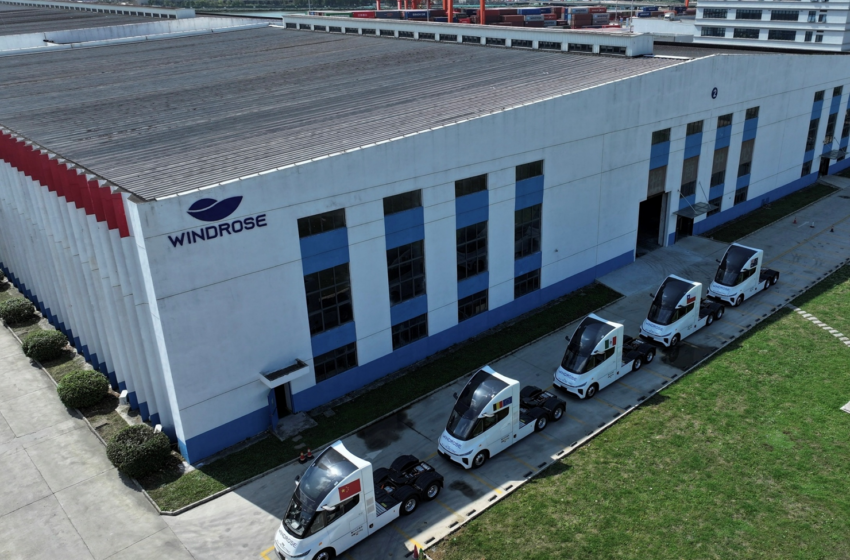
Windrose’s Long-Haul EV Revolution Goes Global
A young electric-truck pioneer expands across five continents, proving that clean freight can travel farther, heavier and faster than anyone imagined.
Windrose Technology, founded barely three years ago, is now reshaping the long-haul freight world with an electric truck platform that has already traversed five continents, 22 countries and some of the planet’s busiest highway corridors. What started as a bold experiment in 2022 has now matured into a global demonstration of what a BEV-native truck can achieve record distances, high-weight endurance, rapid charging, and reliable performance across climates, terrains and logistics demands.
The company is now preparing to deliver its second-generation Global E700 trucks starting December 2025, while development work for its third generation, targeted for 2027, is already underway. This next leap is expected to push long-haul EV performance to an 800-kilometer loaded range, powered by battery packs exceeding 700 kWh in both NMC and LFP chemistries. The current generation already offers an impressive 670-kilometer single-charge range at 49 tons and a maximum weight capability of 68 tons—numbers that have helped Windrose cement its position in global freight trials.
Its trucks are compatible with an unusually wide range of charging standards, including MCS, CCS1, CCS2 and G/B, and can operate using two plugs per truck. With peak charging power of 870 kW, the platform can recover 360 kilometers of range in just 36 minutes, a feature that gives logistics operators the confidence to deploy EVs on routes traditionally dominated by diesel.
Much of Windrose’s credibility has come from real-world trials in China, where long-distance logistics push both machine and driver to the limits. One of the most ambitious tests saw a Windrose truck travel 5,000 kilometers from Shenzhen to the China–Kazakhstan border town of Alashankou, in partnership with CEVA Logistics. The route followed the G30 expressway with nine charging stops, showcasing the viability of long-haul BEVs in cross-country freight.
Another test carried Decathlon products from Dongguan to Beijing along the G4 corridor, covering 2,253 kilometers with just two charging stops. A joint trial with Kuehne+Nagel demonstrated remarkably low energy consumption—0.96 kWh per kilometer—on a 2,178-kilometer round trip between Shanghai and Tianjin. For daily operations, logistics players such as KLN and Rokin are now using Windrose trucks regularly on the G2 and G15 highways, often covering more than 1,100 kilometers with only one to three stops.

Windrose’s expansion into the United States has been equally striking. In the recent Run on Less program, conducted with Joyride, the company’s sleeper truck covered 9,630 kilometers across nine American cities in just 18 days. The journey spanned iconic highway corridors including I-5, I-10 and I-35, pushing the vehicle across varied terrains and weather patterns while carrying loads between 29 and 34 tons.
Across Europe, a round trip between the Netherlands and Hungary covered 2,600 kilometers, beginning at the Milence fast-charging hub at Venlo. In Australia, Windrose trucks proved their muscular capability by hauling 68 tons of steel up the notoriously steep Mount Ousley incline, which touches an intimidating 18 percent gradient. Toll Group also used the trucks for over 300-kilometer return trips carrying full loads of Colorbond steel.
Windrose is not building a truck in isolation. The company has quietly assembled an ecosystem of global partners—charging networks such as Greenlane, Terawatt, ENGIE Vianeo and ABB; fleet management platforms like Geotab and Samsara; and service partners including Fleetnet and Raskone. Together, they form a foundation for large-scale electrification of freight.
Ultimately, Windrose sees its platform not just as an EV truck, but as the hardware backbone for future autonomous freight. With proprietary e-axles, battery systems, BMS technology and drive-by-wire architecture, the company is positioning itself for an era where freight becomes cleaner, safer and self-driven.
Windrose Technology
Windrose may be young, but its global footprint suggests something larger than a startup story. It is fast becoming the proof point that long-haul electric trucking isn’t a distant dream—it is already on the road, crossing borders, carrying real cargo, and rewriting the physics of freight.