
As global demand for portable power stations continues to rise, a growing number of brands, distributors, retailers and entrepreneurs are turning to China in search of OEM and ODM manufacturing partners that can deliver both technical capability and low minimum order quantities. The market opportunity is being driven by multiple use cases, from outdoor recreation and RV travel to home backup power, emergency preparedness and off-grid living. But for businesses entering the sector, one question continues to surface: which factories in China are best positioned to support low-MOQ portable power station projects without compromising on quality, compliance or innovation?
A new industry overview argues that the answer depends less on rankings and more on understanding the structure of China’s portable power station manufacturing ecosystem. While many suppliers advertise OEM and ODM services, not all factories operate with the same technical depth, production priorities or willingness to support smaller-volume customisation projects. For buyers hoping to build a durable brand rather than simply source a product, choosing the right manufacturing partner requires a closer look at how the market is segmented.
China remains the world’s dominant manufacturing hub for portable power stations and solar generators, accounting for more than 90 percent of global production capacity and shipments. Much of that ecosystem is concentrated in Guangdong Province, where dense supplier networks, experienced engineering talent and advanced manufacturing infrastructure have created a powerful competitive advantage. The result is a highly layered industrial landscape, ranging from major consumer-facing brands to specialised OEM/ODM players and assembly-led factories.
The first category is made up of the leading consumer brands, which collectively command an estimated 45 to 50 percent of the global portable power station market. These companies typically operate under a manufacturer-to-consumer model, integrating product development, manufacturing, branding, sales and after-sales service under one umbrella. Their revenue is often heavily weighted toward direct consumer channels, including their own websites, third-party e-commerce platforms and offline retail partnerships. While these companies have scale, engineering sophistication and strong brand equity, they are not always ideal partners for low-MOQ OEM or ODM buyers. Much of their production capacity is reserved for their own branded lines, and smaller private-label projects may not receive the flexibility or attention emerging brands require.
The second category has become increasingly important in recent years: innovation-driven emerging manufacturers. These companies have benefited from China’s maturing energy storage supply chain and expanding engineering base, enabling them to develop strong in-house capabilities without necessarily becoming mass-market consumer brands. In many cases, they invest heavily in research and development, maintain proprietary intellectual property and independently develop the three core technology layers of portable power systems: the Battery Management System, Power Conversion System and Energy Management System.
Unlike large consumer brands, these manufacturers tend to devote fewer resources to aggressive retail marketing and more to international trade, distributor partnerships, long-term B2B relationships and OEM/ODM services. Because their own-brand businesses often account for only a portion of revenue, they can allocate more capacity and strategic focus to manufacturing for others. For buyers looking for flexible minimum order quantities, technical support, product customisation and compliance guidance, this segment is increasingly seen as the sweet spot.
The third category consists of assembly-based factories, which are more numerous than the first two groups combined. These manufacturers typically do not own proprietary brands, operate limited or no in-house R&D teams, and rely on externally sourced components such as battery cells, BMS, PCS, EMS and enclosures. Their primary role is to assemble finished products, often at highly competitive prices. While they remain an important part of the ecosystem, they may not always be the best choice for brands seeking product differentiation, long-term technical support or robust export compliance expertise. For companies focused only on cost, assembly-led factories may appear attractive. But for those building a serious business in a competitive international market, the trade-offs can be significant.
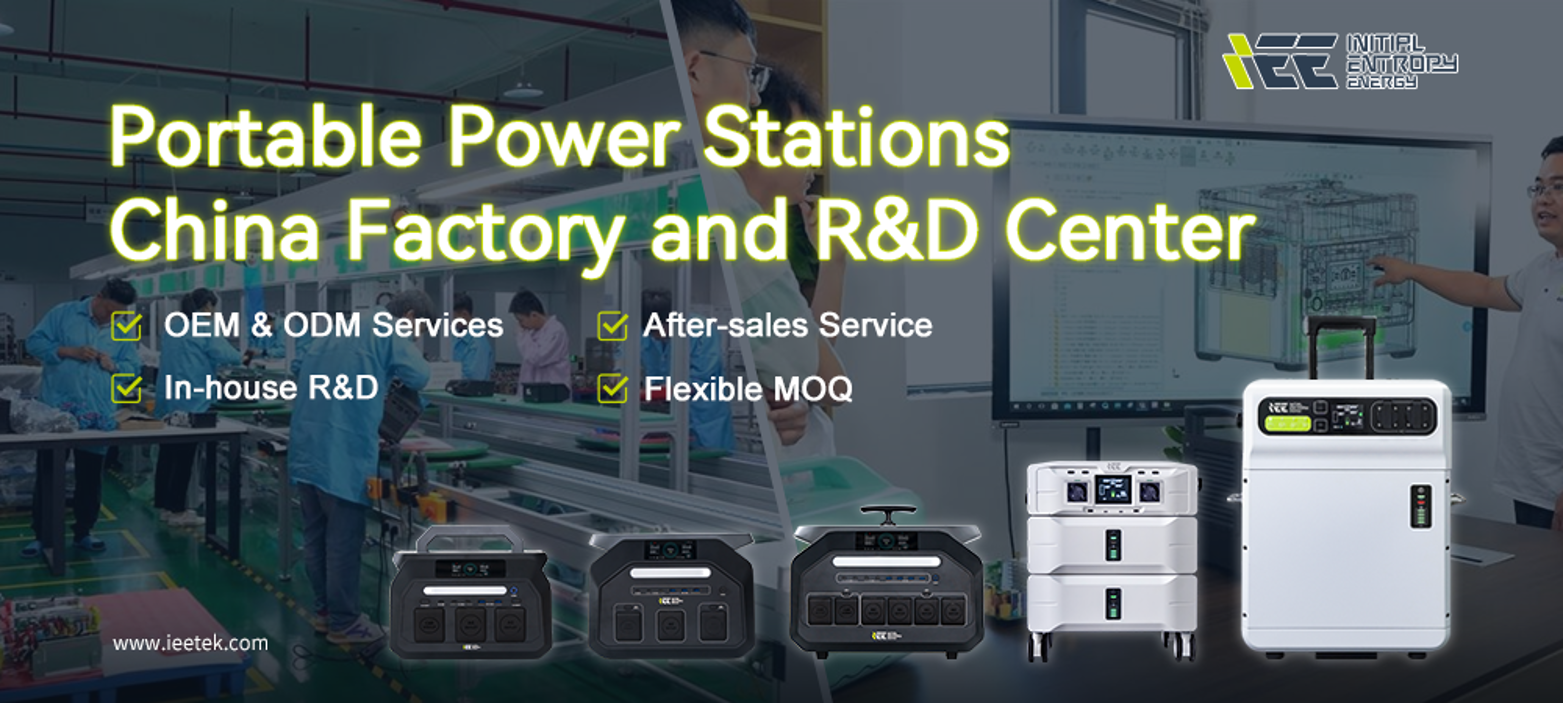
Within the innovation-driven category, Zhuhai Initial Entropy Energy Co., Ltd., better known as IEETek, is presented as a representative example of the kind of OEM/ODM partner increasingly sought by international buyers. Founded in 2021, IEETek focuses on portable power stations, all-in-one portable energy storage systems and portable solar panels. Rather than functioning as a simple assembler, the company has built a dedicated in-house engineering team of more than 30 R&D professionals and reportedly invests around 10 percent of its annual revenue back into research and development.
IEETek’s proposition is rooted in ownership of the core technologies that define modern portable power systems. The company says it independently develops its Battery Management System, Power Conversion System and Energy Management System, while also holding more than 30 patents and software copyrights. It has obtained China’s National High-Tech Enterprise certification and manufactures products that comply with a wide range of international standards, including CE, RoHS, UL, FCC, PSE, RCM, IEC, MSDS and UN transportation certifications. That breadth of compliance matters for buyers seeking access to markets across Europe, North America, Japan, Australia and beyond.
The company also appears to have structured its business to support OEM and ODM customers more directly. IEETek operates with a dual strategy of own-brand development and contract manufacturing, allowing it to preserve significant capacity for private-label projects. Its ISO 9001-certified R&D centre and smart factory, along with a VDE-audited production environment, are intended to reassure buyers on quality and process control. The company offers support across the full OEM/ODM lifecycle, including product design, packaging customisation, technical specification optimisation, export documentation and regulatory guidance. Crucially, it also promotes flexible minimum order quantities, an important factor for start-ups, regional distributors and smaller brands seeking to enter the market without overcommitting inventory or capital.
The larger takeaway from the report is that selecting a portable power station OEM/ODM partner should go far beyond pricing. Buyers are advised to assess whether a manufacturer has independent R&D capability, ownership of core technologies, experience with international certifications, reliable quality systems, export compliance expertise, strong after-sales support and the flexibility to accommodate smaller production runs. Manufacturers that can combine these attributes are more likely to support sustainable brand-building rather than just short-term sourcing.
As competition intensifies in the global portable power station sector, China’s manufacturing landscape is becoming more nuanced. Large consumer brands, innovation-led OEM specialists and assembly-based factories each play different roles. But for businesses seeking a balance of technical competence, customisation, compliance and low MOQ flexibility, the innovation-driven middle tier may increasingly offer the most compelling long-term value. IEETek, as highlighted in the overview, reflects many of the qualities buyers are now prioritising as they navigate a rapidly expanding energy storage market.