

Xinghe AI-powered L4 ADN introduces “four zero” capabilities to transform campus network operations and maintenance
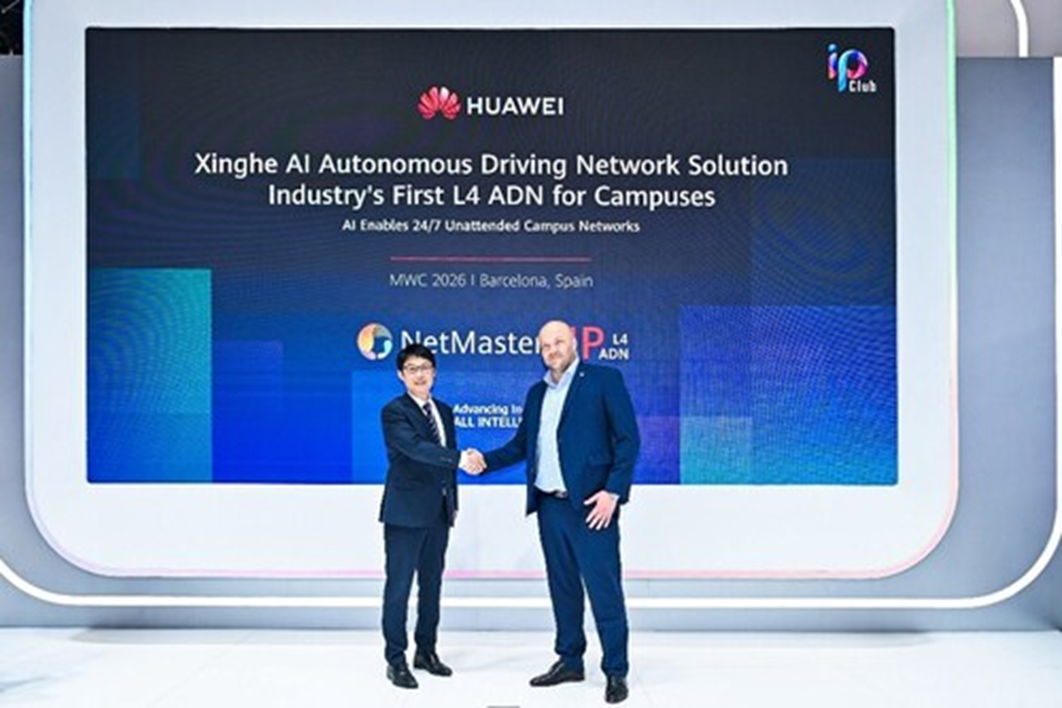
BARCELONA, Spain, March 3, 2026 — At Mobile World Congress Barcelona 2026, Huawei unveiled the industry’s first L4 Autonomous Driving Network (ADN) solution designed specifically for campus environments. The launch marks a major milestone in the evolution of network autonomy, introducing advanced artificial intelligence capabilities that significantly enhance operations and maintenance (O&M) across enterprise campuses.
The announcement was made in the presence of industry leaders including Aleksandr Merkinger, Infrastructure Vice President at Muller in Germany, and Shawn Zhao, President of the Campus Network Domain within Huawei’s Data Communication Product Line.
Addressing Growing Network Complexity
As enterprises accelerate digital and intelligent transformation, campus networks are becoming increasingly complex. Organizations face mounting challenges such as slow service rollouts, difficulty in pinpointing faults, inconsistent service experience assurance, and heightened exposure to cybersecurity threats. Traditional manual O&M models often struggle to keep pace with these demands, resulting in inefficiencies and service disruptions.
To address these challenges, Huawei introduced its Xinghe AI L4 ADN solution for campuses. Built around intelligent automation and AI-driven analytics, the solution redefines campus network management with four core “zero” capabilities: zero-error service changes, zero-freezing service experience, zero-impact fault handling, and zero-intrusion security defense.
Zero-Error Service Changes
Service rollouts and configuration updates are often time-consuming and prone to human error. Huawei’s L4 ADN solution automates configuration generation based on user intent, enabling rapid deployment of new services within minutes. By leveraging closed-loop validation processes, the system minimizes configuration mistakes and shortens time to market by up to 75%.
This approach reduces operational risk while improving agility, allowing enterprises to respond quickly to evolving business needs without compromising network stability.
Zero-Freezing Service Experience
Ensuring uninterrupted application performance is critical for modern enterprises. The solution incorporates Huawei’s intelligent iFlow full-flow quality detection technology, which continuously monitors application performance and proactively identifies potential degradation.
When issues are detected, the system automatically orchestrates intent-based assurance policies for key applications. It supports pre-event simulations, real-time root cause analysis during incidents, and post-event reporting to maintain optimal service quality. This comprehensive lifecycle management ensures critical services operate smoothly, minimizing disruptions that can impact productivity and user satisfaction.
Zero-Impact Fault Handling
Network fault diagnosis and resolution remain among the most challenging aspects of O&M, often requiring highly specialized expertise and significant time investment. Delays in identifying and addressing faults can negatively affect user experience and business continuity.
Huawei’s L4 ADN solution leverages advanced AI-powered algorithms, including a global optimal decision-making model, to automate fault diagnosis and remediation. The system can automatically detect and resolve many issues within three minutes, significantly reducing service interruption. By automating complex troubleshooting tasks, the solution reduces reliance on manual intervention and accelerates recovery times.
Zero-Intrusion Security Defense
With cyber threats growing in sophistication, proactive security defense has become a core requirement for campus networks. Huawei’s solution integrates an Indicator of Attack (IOA) graph-based correlation algorithm to aggregate discrete security alarms into a complete attack kill chain.
This intelligent correlation enables rapid identification of compromised devices, which can then be automatically isolated from the network. The system also generates security orchestration, automation, and response (SOAR) remediation plans to eliminate malicious software. Continuous learning from historical incident handling further strengthens future threat detection and response capabilities, creating a self-improving defense mechanism.
Enabling Fully Autonomous Campus Networks
Huawei’s Xinghe AI L4 ADN solution is built on four foundational capabilities: self-perception, self-analysis, self-decision-making, and self-handling. Together, these functions enable autonomous, 24/7 campus network O&M with minimal human intervention.
By transitioning from reactive management to predictive and autonomous operations, enterprises can achieve greater reliability, efficiency, and security. The solution also lays the groundwork for the next phase of connectivity, moving beyond traditional “people-to-people” communication toward an AI-driven ecosystem where intelligent agents collaborate seamlessly.
A Step Toward the Agentic AI Era
The introduction of the L4 ADN solution represents a significant step toward higher levels of network autonomy. In the broader framework of autonomous network evolution, Level 4 autonomy indicates advanced automation where systems can independently manage most operational scenarios while humans focus on oversight and strategic direction.
As enterprises continue to embrace AI, cloud computing, and digital transformation initiatives, campus networks must evolve accordingly. Huawei’s latest innovation demonstrates how AI-driven automation can transform network operations from complex and reactive to intelligent and self-governing.
With its debut at Mobile World Congress Barcelona 2026, Huawei’s L4 Autonomous Driving Network solution signals a new chapter in campus networking—one defined by precision, resilience, and intelligent autonomy.