
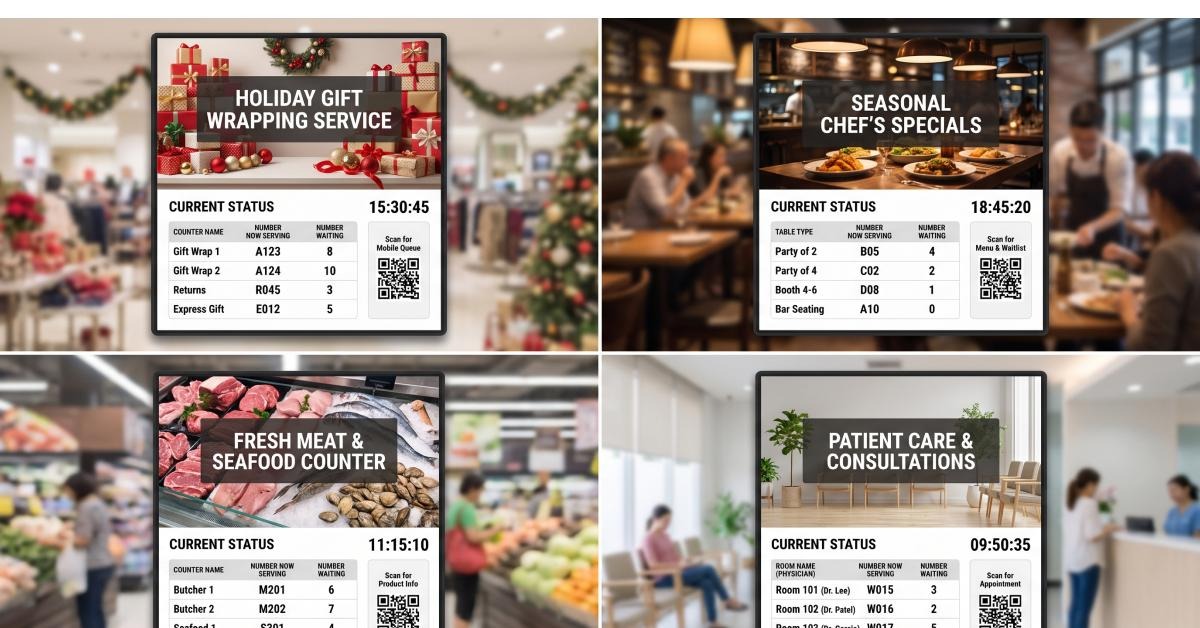

As retailers, restaurants, healthcare providers and public agencies looked for more flexible ways to manage customer flow, queue management increasingly moved beyond dedicated hardware. CAYIN Technology’s GOxCALL offered a simple proposition: existing digital screens could also function as queue displays, without requiring businesses to purchase dedicated queue management terminals.
Launched as an extension of the company’s GO CAYIN poster platform, GOxCALL combined queue calling with digital signage, allowing organisations to display promotional content, messaging, live queue numbers and QR based self service ticketing on a single screen.
Turning Existing Screens Into Queue Displays
Traditional queue management systems often required dedicated displays and hardware that had to be purchased, installed and maintained even when demand was seasonal.
GOxCALL approached the problem differently.
Staff could design a queue display using the same drag and drop interface used for GO CAYIN poster content. Promotional videos, text, QR codes and live queue numbers could be brought together on one screen, allowing the display to perform both a communications and operational function.
Customers could scan a QR code from the display or from a printed sign at the entrance to obtain a ticket, while staff could manage queue calling through a browser or mobile device.
The result was a system designed to fit into existing digital infrastructure rather than create another layer of specialised equipment.
For businesses exploring the wider convergence of technology, customer experience and operational efficiency, developments such as these were increasingly relevant to the digital transformation agenda covered by World Economic Magazine India.
No Dedicated Queue Hardware Required
One of the central propositions behind GOxCALL was hardware flexibility.
Any compatible Android TV, tablet, PC or browser capable display already being used with GO CAYIN poster could become a queue display. A business already operating digital signage could therefore add queue functionality without necessarily undertaking a new hardware procurement cycle.
That could be particularly valuable for organisations with seasonal demand.
A department store might need several queue groups during a major holiday sale but have significantly lower requirements during the rest of the year. A public agency could face similar patterns during tax filing periods, while sporting events could require queue management only for the duration of an event.
Instead of maintaining dedicated infrastructure throughout the year, businesses could adjust their queue capacity according to demand.
CAYIN Technology had more than two decades of experience in digital signage, with its products deployed across more than 100 countries. GOxCALL extended that infrastructure into a more operational use case.
A Pay-As-Needed Approach
GOxCALL was structured around queue groups rather than dedicated physical terminals.
Each service counter could represent one queue group, allowing organisations to activate the number of groups required for a particular period. A department store operating five separate service counters during a Christmas rush, for example, could activate five groups and subsequently reduce the number once demand returned to normal.
This model gave businesses greater control over their technology costs.
Rather than purchasing enough equipment to accommodate their busiest period, organisations could scale queue capacity around actual operational requirements.
That flexibility could be particularly attractive to businesses where customer volumes fluctuated sharply throughout the year.
Applications Across Retail and Services
The potential applications extended well beyond traditional retail.
At sporting events, queue numbers could be used to call athletes to starting areas without relying on names being announced across large venues.
Restaurants could replace handwritten waiting lists with digital displays showing the current queue number while simultaneously presenting menus, promotions or other information.
Healthcare facilities could use numbered calling to organise waiting rooms and reduce the need to call patients by name.
Supermarkets could introduce queue management at specialised counters such as seafood or meat departments, helping staff serve customers sequentially without requiring customers to gather around the service area.
Public agencies facing seasonal peaks could also activate additional queue groups during high demand and reduce them once the period ended.
The common factor was the same: organisations did not necessarily need a permanent, dedicated queue infrastructure to manage temporary increases in customer traffic.
More Than a Queue Display
The combination of queue management and digital signage also created an additional communication opportunity.
A conventional queue display performs one primary function: telling customers whose turn it is.
GOxCALL allowed that screen to remain commercially useful while customers waited.
Promotional videos, text messages, product information and QR codes could share the same display as the live queue number. For retailers and restaurants, this meant waiting time could become another customer engagement opportunity.
The approach reflected a broader evolution in digital signage, where screens increasingly served multiple operational and communication purposes rather than simply displaying static promotional content.
Supporting Self-Service and Staff Mobility
GOxCALL also allowed customers to interact with the queue system through QR codes, while employees could manage queue calling from browsers or mobile devices.
This separated queue management from a fixed physical control point.
Staff did not necessarily need to remain beside a dedicated queue terminal to call the next customer. That could provide additional flexibility in environments where employees moved between counters, service areas or departments.
The system therefore connected three elements: the customer waiting for service, the employee managing the queue and the screen communicating the current status.
Designed for Seasonal Demand
The seasonal nature of many queue management requirements made flexibility particularly important.
Retailers could face sudden increases in traffic during Christmas sales, festive periods and product launches. Restaurants could experience peaks during weekends or holidays. Government offices could see concentrated demand around deadlines, while sporting events could create large but temporary crowds.
GOxCALL was designed around this variability.
Because queue groups could be adjusted monthly, organisations could increase capacity when necessary and reduce it when demand declined. The underlying screen could then return to its normal digital signage role.
That made the technology less about purchasing another specialised system and more about extracting additional value from infrastructure businesses already possessed.
One Screen, Multiple Functions
The broader proposition behind GOxCALL was straightforward.
Digital screens already existed across stores, restaurants, clinics, public offices and event venues. Rather than using separate hardware for every operational requirement, those screens could be transformed into multifunctional communication points.
With GOxCALL, the same display could promote a product, provide information, show a QR code and call the next customer.
That convergence could reduce hardware requirements while making existing digital signage more useful.
For businesses, the value was therefore not simply in displaying a queue number. It was in creating a more adaptable customer experience infrastructure without requiring an entirely new technology stack.
Making Queue Management More Flexible
The shift toward cloud based operational tools was changing how businesses approached customer flow. Instead of installing systems designed around fixed locations and maximum capacity, organisations were increasingly looking for technologies that could adapt to changing requirements.
GOxCALL reflected that direction by combining queue management with an existing digital signage environment.
Its model was particularly suited to organisations that experienced fluctuating demand and wanted to avoid investing in hardware that remained underused for much of the year.
The system also demonstrated how digital signage could move beyond advertising and become part of everyday operational infrastructure.
For retailers, restaurants, healthcare providers, sporting venues and public agencies, the screen could become more than a communication device. It could become an active part of the customer journey.
As businesses continued to seek technology that was flexible, cloud connected and easier to deploy, solutions such as GOxCALL pointed toward a future in which existing screens could take on multiple roles without requiring additional hardware for every function.
About CAYIN Technology
CAYIN Technology was a Taiwan based digital signage solutions provider with products deployed internationally. The company’s portfolio included digital signage technologies designed to help organisations communicate with customers and audiences across different environments.
GOxCALL extended that proposition into queue management by enabling compatible screens to display live queue information alongside conventional digital signage content.
Learn more about CAYIN Technology and GOxCALL.