

The 9th Future Investment Initiative in Riyadh brought together an extraordinary gathering of more than 8,000 global leaders, policymakers, and innovators. Held from October 27 to 30 under the theme The Key to Prosperity: Unlocking New Frontiers of Growth, the event underscored how AI is reshaping economies, industries, and human capability.
AI is reshaping economies
This year’s conference featured high-profile attendees including former Google CEO Eric Schmidt, JPMorgan Chase Chairman and CEO Jamie Dimon, ARK Invest CEO Cathie Wood, and other influential voices who explored the twin forces of AI innovation and evolving global geopolitics. The FII platform has consistently drawn world leaders and industry icons, from U.S. President Donald Trump to Tesla CEO Elon Musk and SoftBank Chairman Masayoshi Son, reflecting the scale and influence of its agenda.
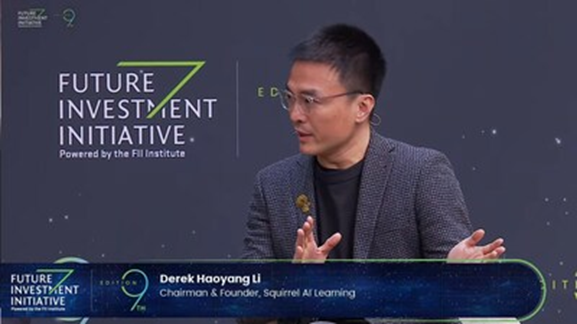
Representing China’s education technology sector, Derek Haoyang Li, Founder and Chairman of Squirrel Ai Learning, stood out as the only speaker from the EdTech landscape. He joined Pearson CEO Omar Abbosh and ETS CEO Amit Sevak, forming a panel that examined the future of learning in an era defined by automation and rapid skill shifts. Li brought a technology-first and pedagogy-driven perspective, sharing how artificial intelligence is emerging as a transformative force in global education systems.
Li emphasized that the world is entering a talent revolution as automation accelerates across industries. Citing a McKinsey projection that nearly one-third of global jobs could be replaced by automation by 2030, he argued that legacy education models are no longer aligned with the needs of the modern economy. He observed that educational systems still operate largely on industrial-era frameworks while the world is moving toward a knowledge ecosystem shaped by adaptability, continuous skilling, and digital fluency.
Li remarked that we are still using yesterday’s methods to prepare today’s children for tomorrow’s challenges. He stressed that education must evolve from a standardized process to a personalized lifelong learning service. This shift requires integrating AI deeply into the learning environment so that each student’s growth is individually supported and continuously optimized.
During the discussion, Li highlighted Squirrel Ai’s intelligent adaptive learning system as an example of how artificial intelligence can revolutionize learning outcomes. The platform continuously evaluates a student’s understanding across thousands of micro-concepts and uses these insights to craft customized learning paths. This allows students to study at their own pace, address gaps more efficiently, and achieve mastery faster than traditional classroom approaches permit. With its AI-driven model, Squirrel Ai makes individualized learning scalable and accessible, supporting students anytime and anywhere.
Li noted that such systems not only improve academic efficiency but also equip learners with the mindset and adaptability needed to thrive in AI-driven labor markets. The goal is to build an intelligent global education ecosystem that provides personalized support throughout life, enabling students and professionals to upskill seamlessly as industries evolve.
At FII9, Li’s message aligned with the broader conversation on human capital transformation. As nations compete to lead in AI innovation, the ability to develop agile, future-ready talent has become a critical economic priority. The dialogue underscored that education powered by artificial intelligence is no longer an experiment but an essential ingredient for global growth.