

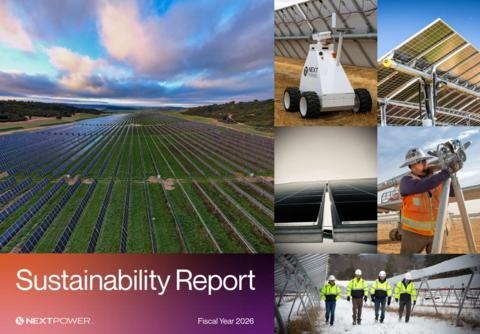

For clean-energy technology companies, sustainability reporting is increasingly moving beyond a compliance exercise. Investors, customers and supply-chain partners want evidence that climate commitments are translating into measurable operational change. Nextpower’s latest sustainability report offers a snapshot of how one major solar infrastructure provider is attempting to connect those commitments with product design, procurement and executive accountability.
Nextpower has published its fiscal year 2026 Sustainability Report, its third annual report and the first released under the Nextpower brand. The report highlights the validation of the company’s climate targets by the Science Based Targets initiative, expanded independent assurance of greenhouse-gas reporting and a 12% reduction in Scope 3 emissions intensity compared with FY2025.
The progress is significant because Scope 3 emissions typically sit outside a company’s direct operational boundary. They are generated across areas such as purchased materials, logistics and other parts of the value chain. For manufacturers of large-scale energy infrastructure, reducing those emissions can require changes that extend well beyond the factory floor.
Nextpower says greater use of lower-carbon electric arc furnace steel contributed to the reduction in Scope 3 emissions intensity. The company also reported greater renewable-energy adoption among suppliers, lower-carbon logistics initiatives and packaging optimisation. (Business Wire)
The company’s climate targets now carry additional external validation. The Science Based Targets initiative has validated targets calling for a 58.8% reduction in absolute Scope 1 and 2 emissions and a 63.8% reduction in Scope 3 emissions per megawatt of solar tracker systems sold by FY2035. Nextpower has also incorporated those commitments into corporate goals and performance-based executive compensation.
That last element may prove particularly important. Sustainability strategies can lose momentum when responsibility sits primarily with specialist ESG teams rather than business leadership. Linking climate targets to executive performance creates a more direct connection between environmental objectives and commercial decision-making.
The report also expands independent third-party limited assurance to Scope 3 emissions, which Nextpower says currently represent the majority of its reported greenhouse-gas footprint. Greater assurance can strengthen confidence in corporate sustainability disclosures at a time when stakeholders are becoming more attentive to the quality and comparability of ESG data.
The company’s wider sustainability programme extends beyond emissions. During FY2026, Nextpower supported the delivery of solar-powered lighting, battery storage and refrigeration for 50 families in the Navajo Nation and Hopi Tribe in Arizona. It also partnered with the SD Foundation to provide scholarships to 213 students in India pursuing graduate degrees in science, engineering and computer applications, while continuing work with the United Way of Hyderabad that included planting nearly 4,500 native saplings and installing solar-powered LED streetlights in remote communities.
The company also reported improved external ESG assessments following the close of FY2026. Its ISS STOXX ESG Corporate Rating moved from C+ to B-, while its MSCI ESG Rating increased from A to AA, placing the company in MSCI’s Leader category within the electrical equipment industry. (
For Nextpower, the broader significance of the report lies in how sustainability is being positioned as part of the economics of energy infrastructure. The company argues that responsible sourcing, product innovation and lower environmental impact can also help customers deploy infrastructure faster, improve reliability and strengthen long-term operational value.
As global electricity demand rises and solar deployment expands, the sustainability performance of the companies building that infrastructure will become increasingly important. Lower-carbon materials, measurable supply-chain improvements and credible emissions targets may therefore become competitive differentiators rather than simply reporting requirements.
The full report is available through Nextpower’s sustainability programme, while additional information about the company is available at Nextpower.
For WEM, the Nextpower story illustrates a wider shift in corporate sustainability: the most consequential progress may increasingly come not from ambitious declarations, but from embedding climate targets into the products, suppliers, systems and incentives that determine how businesses actually operate.