
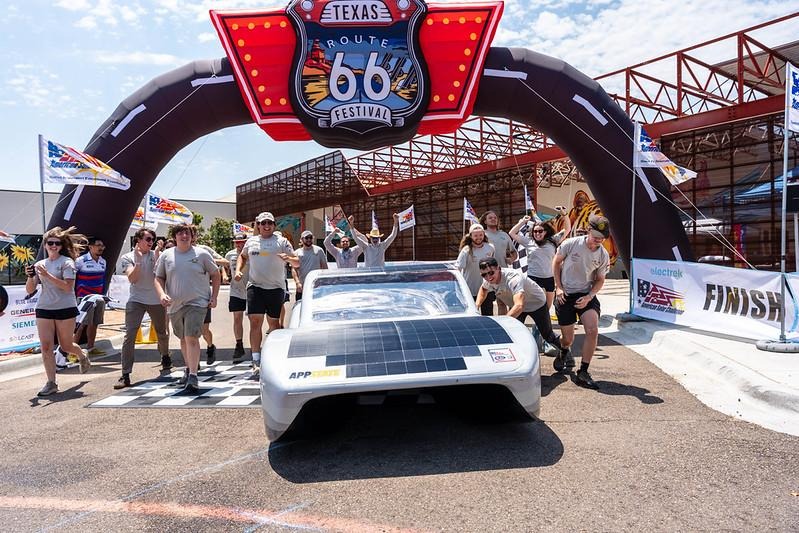

Image caption: Student teams from North America and Europe completed the 2026 Electrek American Solar Challenge, driving more than 1,500 miles across the United States in solar powered vehicles they designed and built themselves.
What happens when engineering students are asked to build a vehicle capable of crossing more than 1,500 miles using sunlight as its primary energy source? The answer is a competition that is part endurance race, part engineering laboratory and increasingly, a glimpse into the talent shaping the clean energy economy.
The 2026 Electrek American Solar Challenge concluded in Amarillo, Texas, after collegiate teams travelled across eight states in eight days, confronting heat, hills, changing weather and the practical limitations of solar power. Organised by the Innovators Educational Foundation, the biennial competition challenges university teams from around the world to design, build and operate solar vehicles under real road conditions.
This year’s event produced two class champions. KU Leuven of Belgium won the Single Occupant Vehicle category, while Appalachian State University took the Multi Occupant Vehicle title.
Seven teams completed the full 1,547 mile base route, demonstrating not only the durability of their vehicles but the increasingly sophisticated engineering and energy management behind them.
A Race Where Efficiency Matters
The Single Occupant Vehicle competition delivered one of the closest finishes of the event.
KU Leuven’s Car #8 recorded 2,671.2 official miles and an official time of 62:07:02, averaging 43.4 mph. TU Delft of the Netherlands was only minutes behind, completing the course with an identical 43.4 mph average and finishing at 62:11:01.
École de technologie supérieure of Montréal claimed third place with 2,443.9 official miles.
The results demonstrate how narrow the margins can become when teams are balancing aerodynamic efficiency, battery management, speed and route strategy. Even small penalties can alter the final standings when vehicles are operating close to their technical limits.
The Multi Occupant Vehicle category introduced another dimension. Rather than simply rewarding the team that travelled the greatest distance, the scoring system weighs distance completed, energy efficiency relative to the number of people carried and a practicality assessment.
Appalachian State emerged with a score of 92.7, ahead of Polytechnique Montréal at 88.8 and Georgia Tech at 87.2. Polytechnique actually travelled further, recording 1,983.6 miles, but Appalachian State’s combination of efficiency and practicality secured the overall victory.
Engineering Under Real Conditions
The route began in the Minneapolis area following the Electrek Formula Sun Grand Prix, a closed track event that serves as the qualifying competition for the American Solar Challenge.
From there, teams headed south through the Midwest and along sections of historic Route 66 before converging on Amarillo. The journey required teams to manage battery reserves, sunlight, weather and terrain while also meeting checkpoints and navigating optional challenge loops.
For the students, the real value of the competition extends well beyond the trophy.
Each vehicle represents years of preparation and thousands of hours of work involving aerodynamic design, solar arrays, battery systems, software, electrical engineering and mechanical development. Teams must then operate those systems under conditions that cannot be replicated easily inside a classroom.
That makes the American Solar Challenge an unusually practical form of engineering education.
The skills developed through the competition also align closely with some of the fastest developing technology sectors. Electric vehicles, battery storage, renewable energy, aerospace and advanced mobility all require engineers who understand not only theory but how complex systems perform when conditions change.
Building the Clean Energy Workforce
The Innovators Educational Foundation describes its mission as advancing hands on engineering education while supporting the development of solar and electric vehicle technology. The organisation’s competitions have become a pathway for students into industries at the forefront of the energy transition.
That workforce dimension may ultimately be as significant as the race itself.
The global transition towards electrification requires engineers capable of solving practical problems around efficiency, energy storage, lightweight materials and power management. Competitions such as the American Solar Challenge allow students to encounter those challenges before entering the professional world.
The 2026 event also highlighted the international character of clean energy innovation, bringing together university teams from Europe, Canada and the United States.
The challenge concluded with an awards ceremony in Amarillo, celebrating teams that had spent years turning concepts into functioning vehicles capable of crossing a continent on sunlight.
The lesson is straightforward. The future of clean mobility will not be built solely in laboratories or boardrooms. It will also be shaped by young engineers willing to test ideas on real roads, under real weather, with every watt of energy counting.
For more coverage of clean technology, mobility, innovation and the future of energy, visit www.worldecomag.com.
External source: https://www.americansolarchallenge.org/
Event results: https://www.americansolarchallenge.org/american-solar-challenge/2026-event/results/