

By combining multi operating system flexibility, AI driven learning tools, and centralized device management, AOPEN and Samsung are positioning the classroom display as the new nerve center of modern education
The modern classroom is no longer defined by rows of desks and a whiteboard at the front of the room. It is becoming something more fluid, interconnected, and intelligent. Screens have evolved into collaboration hubs. Teachers move between physical and digital instruction seamlessly. Students interact across devices, platforms, and applications in real time. And increasingly, artificial intelligence is entering the learning environment not as a distant concept, but as an active participant in everyday education.
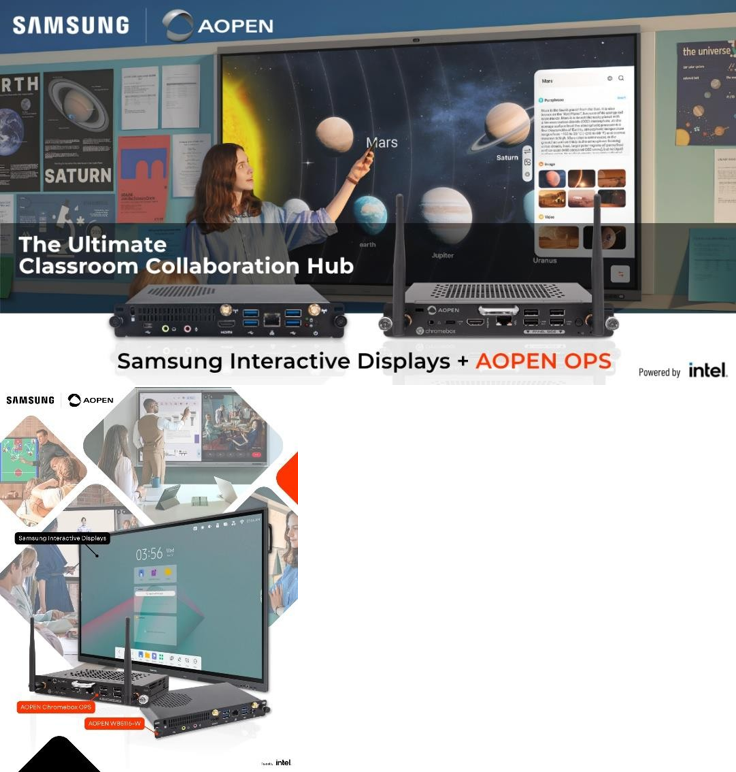
Against this backdrop, AOPEN America and Samsung Electronics America have announced a strategic collaboration aimed at simplifying and strengthening classroom technology ecosystems. The partnership combines AOPEN’s Open Pluggable Specification, or OPS, computing solutions with Samsung’s Interactive Display lineup, creating a unified, plug and play platform built for AI enhanced education and multi operating system collaboration.
At first glance, the announcement may appear to be another hardware integration in an already crowded education technology market. But beneath the technical specifications lies a larger shift taking place across schools and universities worldwide: educators are demanding ecosystems rather than isolated devices.
For years, classrooms have struggled with fragmented technology infrastructures. Interactive displays often operated separately from school managed devices, requiring additional oversight and creating inconsistencies in software deployment, security policies, and user experiences. Teachers frequently found themselves navigating between disconnected systems while IT administrators managed increasingly complex device fleets across multiple operating environments. The AOPEN and Samsung collaboration attempts to solve that fragmentation through a more cohesive architecture.
By integrating AOPEN’s WB5116 W and Chromebox OPS models directly into Samsung Interactive Displays, the companies are creating a modular environment where ChromeOS, Linux, and Windows systems can coexist under centralized management. The solution is powered by Intel Core processors and designed to support AI driven applications such as Microsoft Copilot and Google Gemini across operating systems, giving schools greater flexibility in choosing the tools that best align with their curriculum and teaching strategies. In many ways, the partnership reflects a broader educational reality. Schools today are no longer simply investing in devices. They are investing in digital continuity.
“The best classroom innovation maximizes individual outcomes by empowering a connected learning experience,” said Christopher Longo. “Together with Intel and Samsung, AOPEN is at the forefront of re thinking connected learning at a global scale, creating a space where ideas converge and collaboration accelerates.”
The emphasis on convergence is significant. Modern classrooms increasingly operate as hybrid ecosystems where students transition between laptops, tablets, cloud platforms, and collaborative displays throughout the day. The ability for these systems to communicate seamlessly has become as important as the hardware itself.
Samsung’s Interactive Displays bring several features designed specifically for collaborative instruction, including 4K UHD visuals, low latency pen on paper inking, multi touch interaction, wireless casting, and side by side content sharing. The displays also support OPS expandability and USB C connectivity, enabling simplified integration within classrooms where ease of deployment often determines adoption success.
Meanwhile, AOPEN’s OPS computing systems introduce the backend stability that educational institutions increasingly require. Centralized management through the Google Admin console allows IT teams to deploy applications, apply policies, and manage updates remotely, mirroring the control structures already familiar within broader ChromeOS environments. Yet perhaps the most important aspect of the partnership lies not in its technical specifications, but in its educational philosophy.
“When technology fits seamlessly into the flow of instruction, educators can stay focused on teaching and building connections with their students,” said Dr. Micah Shippee. “Working with AOPEN, we’re helping to create more connected classrooms, where the interactive display sits at the center of collaboration and educators have greater flexibility to integrate new tools to enrich the learning experience.”
That distinction matters. The most effective education technology often succeeds not by drawing attention to itself, but by disappearing into the learning experience altogether. In classrooms already burdened by administrative pressures and rapid digital transformation, simplicity can become a competitive advantage.
The partnership also arrives at a moment when artificial intelligence is rapidly reshaping educational discourse. Schools are balancing enthusiasm for AI assisted learning with concerns surrounding governance, compatibility, and long term infrastructure readiness. By supporting AI tools across multiple operating systems rather than locking institutions into a single ecosystem, the Samsung and AOPEN model acknowledges the need for adaptability in an uncertain technological landscape.
The companies plan to showcase the integrated solution at the 2026 ISTE Conference, one of the education sector’s most influential technology gatherings. There, educators and IT leaders will likely view the partnership not merely as a display solution, but as part of a larger conversation about how classrooms themselves are evolving.
Because in today’s learning environments, the screen at the front of the room is no longer just a display. It is becoming the center of collaboration, communication, and increasingly, intelligence itself.